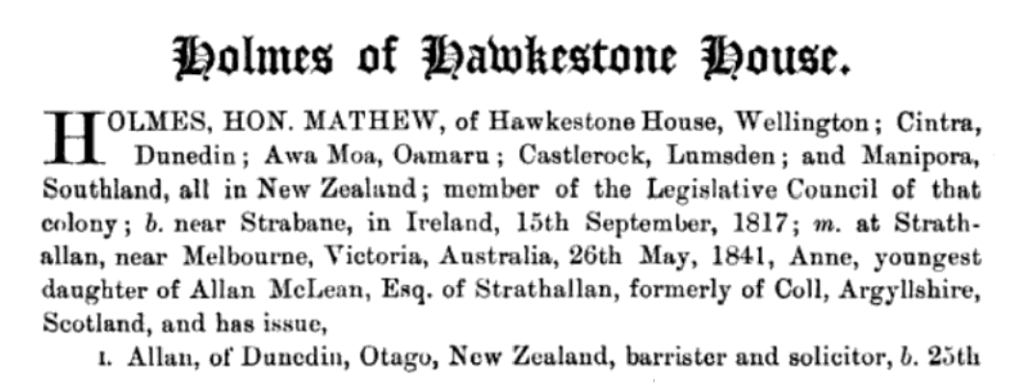
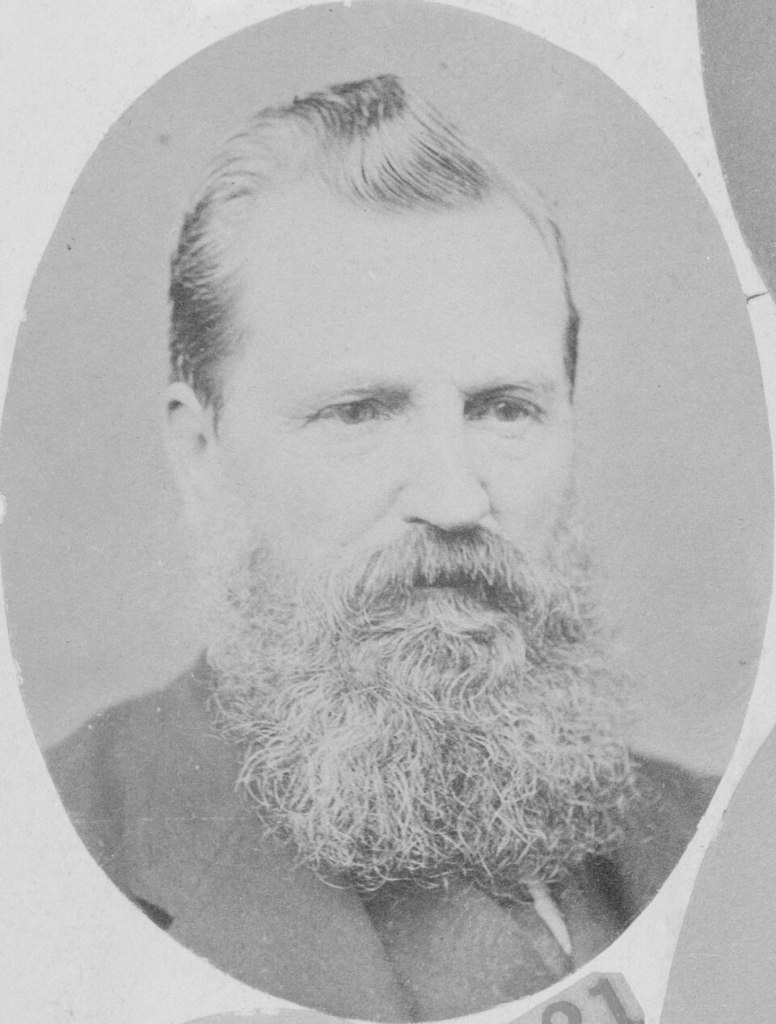
Earlier this year, I became aware of another YDNA match with family origins near Strabane, Ireland. A decendant of Mathew Holmes of Hawkestone House, NZ has tested and is a match to Holmes Group 01 of the Holmes YDNA project. He is thus another confirmed cousin of mine. We liklely share a common ancestor born before 1600.
Ballycolman, Urney parish
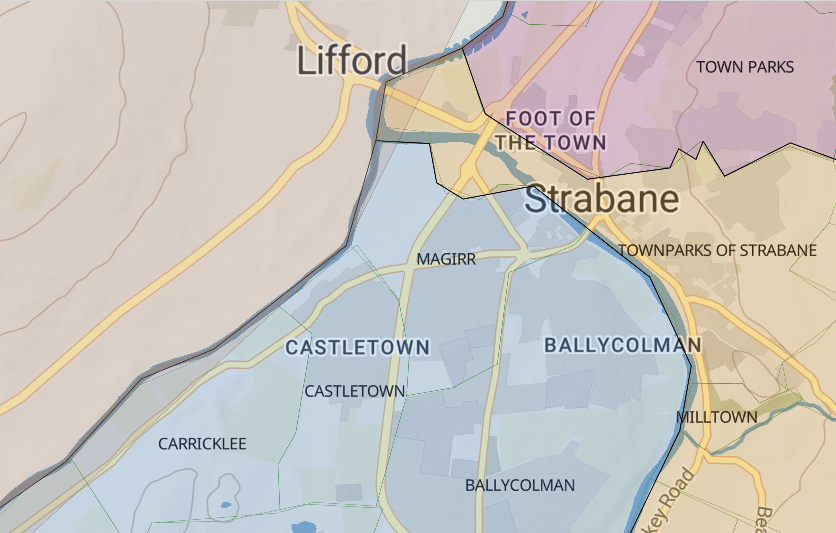
Mathew Holmes was born on 15 September 1817 at Ballycolman, Urney parish, just outside of Strabane. [Urney is a parish that has been of particular interest to me. It is located just south of Strabane, Co Tyrone where my ancestor, Rev William Homes was minister from 1692-1714. The Fasti of Prebyterian Church of Ireland states that his cousin, another Rev William Holmes, was minister at Urney from 1696-1734. See my bog post here.]
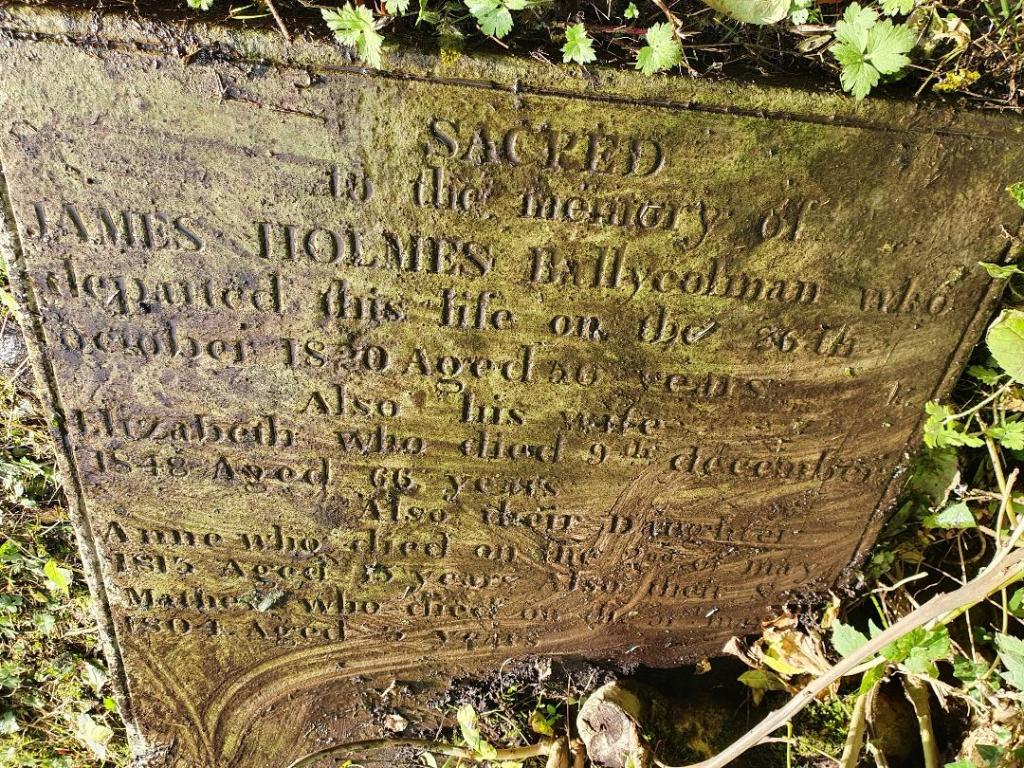
Burke states that the immediate ancestors of Mathew Holmes were farmers residing at Strabane, in Ireland, for about 150 years. Mathew’s father was James Holmes, a farmer, born about 1763. His mother was Elizabeth Watson. James Holmes died on 26 October 1820, aged fifty-six, when Mathew was three years old. The gravestone (photo courtesy of Sarah Holmes, a descendant) lies in the old burial ground at Urney. It records that before Mathew was born, his parents had already buried two children: a daughter Anne, who died on 2 May 1813 aged fifteen, and a son — also called Mathew — who died on 3 May 1804, aged five.
SACRED
to the memory of
JAMES HOLMES Ballycolman who
departed this life on the 26th
October 1820 Aged 56 years
Also his wife
Elizabeth who died 9th December
1848 Aged 66 years
Also their Daughter
Anne who died on the 2nd of May
1813 Aged 15 years. Also their Son
Mathew who died on the 3rd of May
1804 Aged 5 years
So Mathew born in 1817 carried a dead brother’s name. That was ordinary practice in Ulster families, and it tells you something about the household he came into. His mother Elizabeth lived on at Ballycolman for another twenty-eight years, dying on 9 December 1848. By then at least 2 sons and a daughter were on the other side of the world and had been for several years.
Melbourne, Australia
Mathew left Ballycolman for Australia arriving there November 15, 1839 on the William Metcalfe after a voyage of 113 days from Plymouth, England to Port Phillip, now Port Melbourne, Australia.
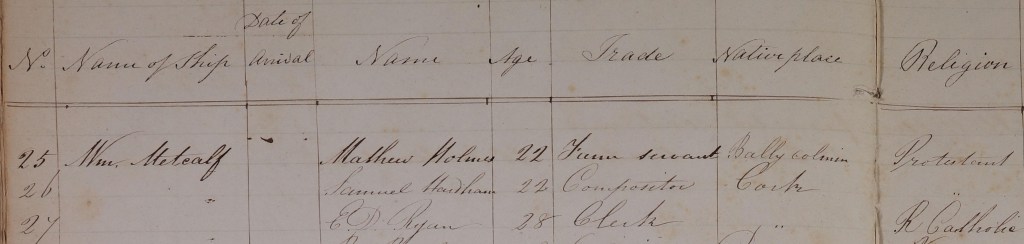
The Port Phillip District in the late 1830s was barely a settlement. Melbourne had been founded in 1835 and was a few streets of timber and canvas.
On January 1, 1841 Holmes went into trade there as a stationer, in partnership with William Kerr, a printer and newspaperman, under the name of Kerr and Holmes.
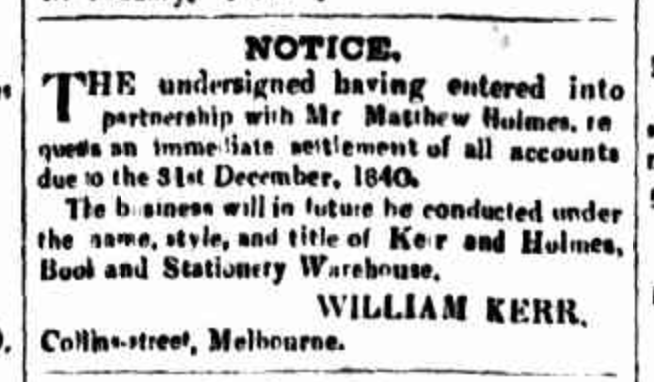
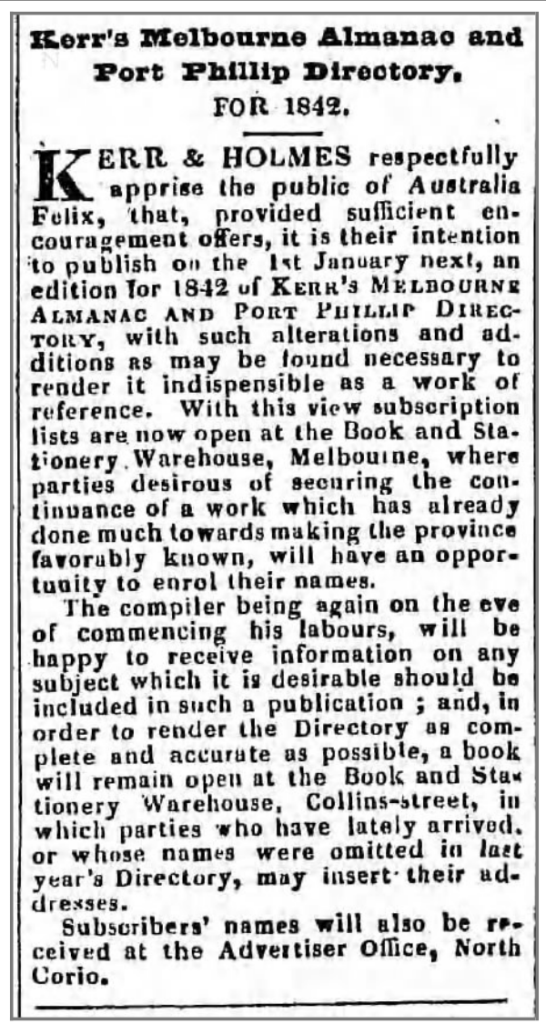
The venture failed. The partnership was dissolved before the end of the year. The following series of notices appeared in the Melbourne Port Phillip Patriot and Melbourne Advertiser on December 30, 1841.
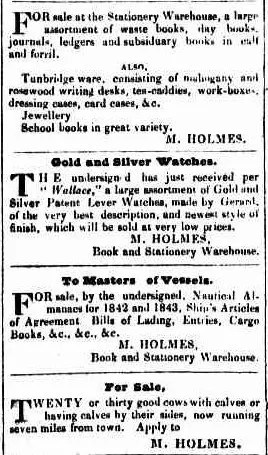 | 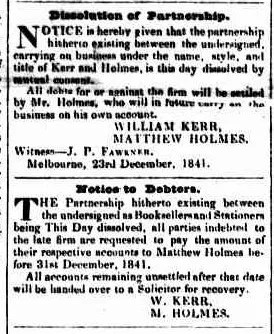 |
An insolvency case ensued and was not finalized until October 1845. The proceedings of the case were reported in the local newspapers, and they do provide some tidbits of family information:
Port Phillip Gazette, Saturday 1 April 1843, page 2
Insolvent sworn. — Have nothing belonging to my brother, but one cask of butter. I have in my possession £.9 belonging to him. There are thirteen head of cattle running on my brother’s station belonging to my estate.Port Phillip Gazette, Wednesday 12 April 1843, page 1
The insolvent sworn and examined by Mr. J. P. Fawkner. — I sold twenty-eight head of these cattle to my brother for £140. I had the use of all his money from tho time he came to the colony up to that date, and because I could not pay him he took these cattle in part payment. I received £100 in cash, £35 in goods, and £12 from Frizzel for flour. I account for having said that this money was paid into the partnership from the circumstance of having received it from my brother in August, 1841….My brother’s cattle, thirty-four cows and the increase, are now on the run ; the cattle mentioned in my schedule belonging to my estate are running on my brother’s station, and Williamson’s and Laing’s ; the station became my brother’s in May, 1842, but he became accountable to Mr. Campbell for the rent before my failure. The property that my wife claims from the estate of her deceased brother H. McLean.Port Phillip Gazette, Saturday 23 September 1843, page 3
Mr Anne Holmes sworn and examined by Mr. Moor.- I am wife of the Insolvent. I am sister of Neil McLean, he left direction with Mr. Power the auctioneer to sell a piece of land in the Town of Melbourne. I am not aware of my brother saying anything to Mr. Power as to the disposal of it. My brother told me that the money arising from the sale of the land was to be solely appropriated to my use. I believed the land in question formerly belonged to, Hugh McLean, my deceased brother, I received £l07 8s. 5d. I received the money myself from Mr. Power….
Miss Catherine McLean sworn and examined. — I am sister to Neil McLean. Neil McLean told me about a week previously to his doing so, that he intended giving instructions to Mr. Power, to sell a piece of land the proceeds of which were to be given to my sister Mrs. Anne Holmes for her support. He told me at the same time that he was afraid Mrs. ‘Holmes would be left in destitute circumstances, there-fore that he left the money arising from the sale of .this land, exclusively for her use and support, and to be wholly independent of her husbands control.
By 1847 Mathew had recovered enough to buy land in the Barrabool Hills above Melbourne, where his brother James also owned property. Then came the events of family lore. A ship lay in Corio Bay, loaded with wool and ready to weigh anchor for London, when fire broke out aboard her. Every effort was made to put it out. In the end they brought up some old pieces of cannon and bombarded her from the shore until she sank. At the salvage sale the young firm were the successful bidders, backed by the Glasgow house of Potter, Wilson & Co. through their Melbourne agents. The wool was recovered, and the speculation, as one account puts it, turned out a grand success.
Black Thursday
On 6 February 1851 — Black Thursday — fire swept across Victoria on a day of terrible heat and wind.
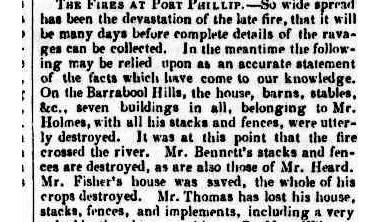
The Holmes family were burnt out at Barrabool Hills. Mathew’s youngest child died of the effects. That was almost certainly Catherine, not yet three. When another daughter was born seven years later in Scotland, she was given the name Kate.
The family endured, and continued to prosper despite the losses.
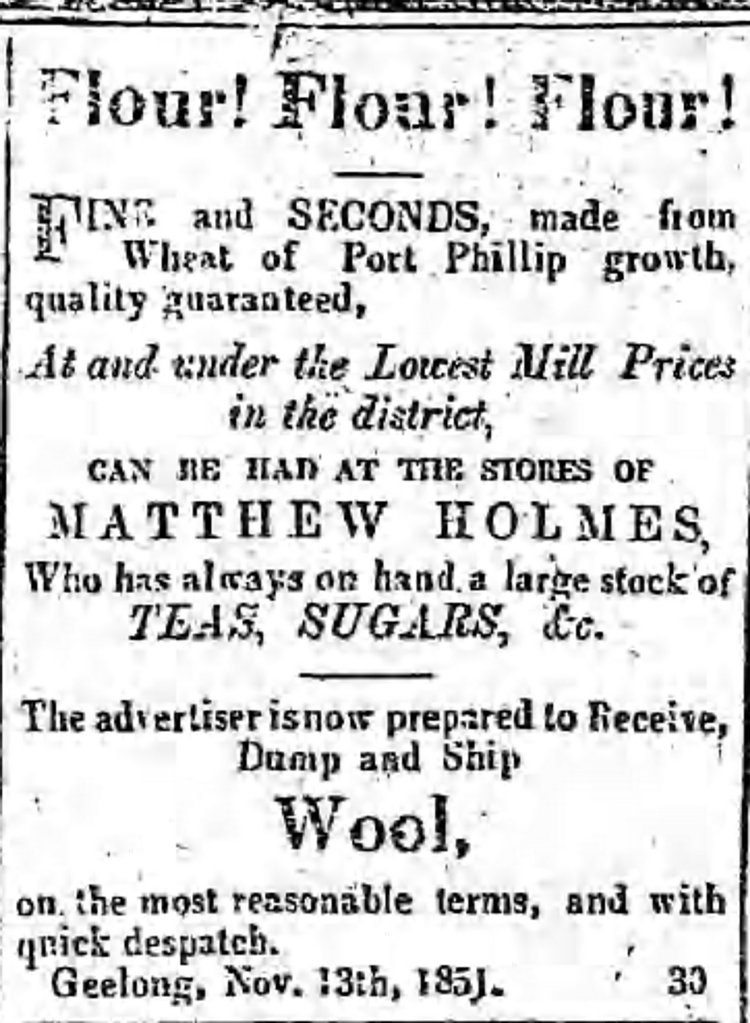
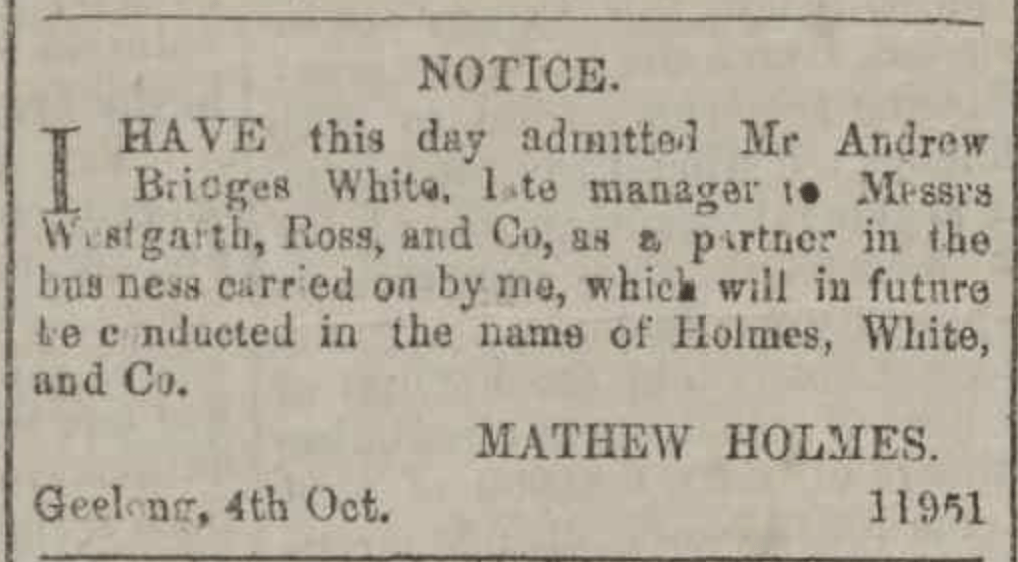
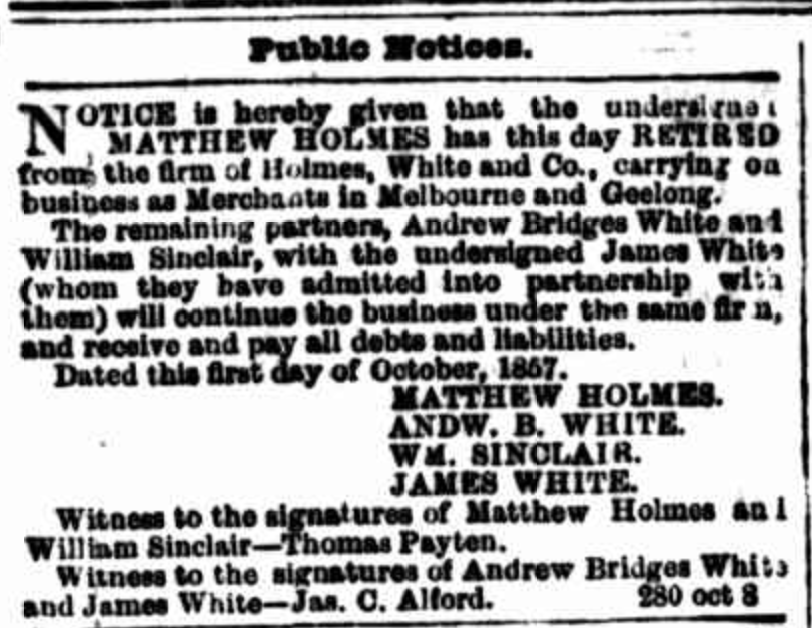
In 1852, Mathew entered into business with Andrew Bridges White thus creating the firm Holmes, White an Co.
Mathew resigned in 1857, but the firm continued quite successfully for a number of years.
Marriage
In 1832 Allan Maclean from the isle of Coll in Argyllshire sailed from Scotland in September 1832 in a small schooner, the John Dunscombe, Allan and two of his sons working the ship as crew. They settled noth of Melbourne at Darebin Creek, on a property called Strathallan — seventeen hundred acres. Mathew married Anne, the youngest of Allan’s five daughters.
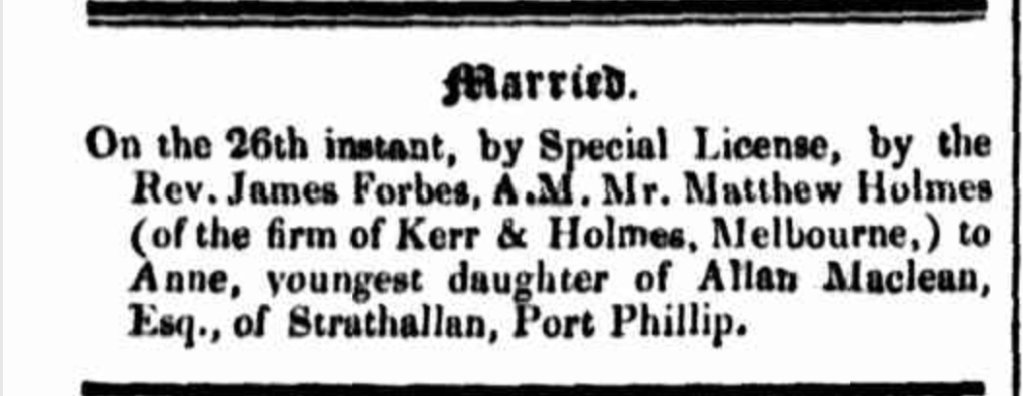
On 26 May 1841, by special licence, the Rev. James Forbes of the Scots’ Church, Melbourne, married Mathew Holmes, late of Strabane to Anne, youngest daughter of Allan McLean, Esq., of Strathallan. He was twenty-three; she was about twenty-two.
The notice ran in the Londonderry Standard and the Belfast News-Letter the following year.
A brother and sister follow Mathew
Seven weeks after that wedding, on 17 July 1841, the ship England landed at Port Phillip. Among the passengers were Mathew’s brotherJames Holmes, a labourer from County Tyrone, and his sister Jane Holmes, a housemaid, also from Tyrone.
Jane Holmes married Anne’s brother, Malcolm McLean in 1843.
James married Eliza Jane Brown in 1844. Her family had arrived on the ship Frankfield in June 1841, the month before James arrived. Here we have an interesting connection to the Holmes of Holmestown family. Eliza was the daughter of William Brown of Convoy, Co Donegal and his wife Margaret Holmes the daughter of Thomas Holmes of Glenfin and his wife Catherine Parker. Thomas being the son of Charles Holmes of Meenahoney or Holmestown and his wife Mary Foster. An outline Holmes of Holmestown family tree starting with Robert Holmes of the Isle of Wight can be found here.
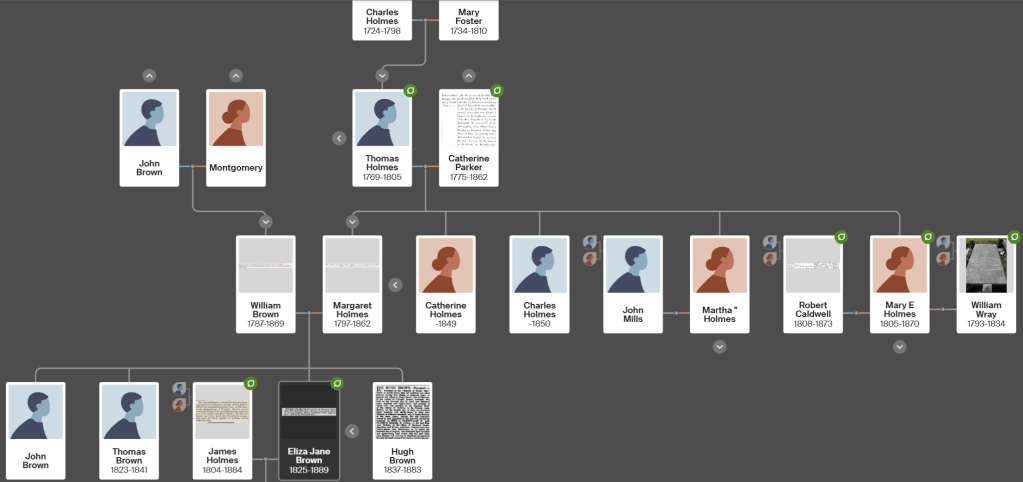
James Holmes settled at the Barrabool Hills, the farming country west of Geelong — the same locality where Mathew and Anne were living. By February 1861 he had moved to Gisborne where he established a large farm with his Brother-in-law, Hugh Brown. Tragically, Hugh died in 1883 when he fell from his horse.
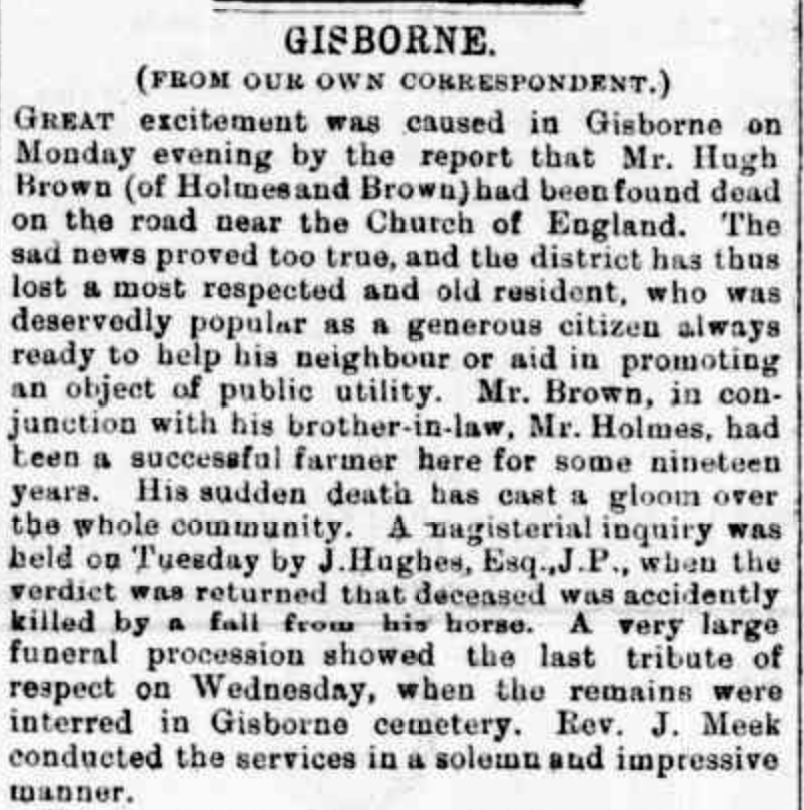
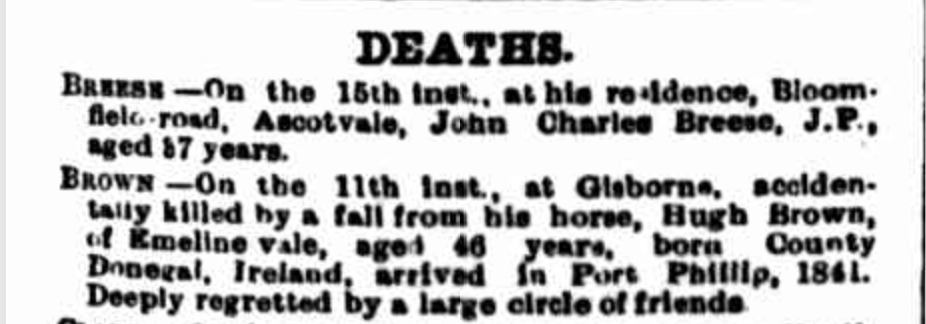
James Holmes died the following year in 1884 at his farm near Gisborne.

An estate near Edinburgh
Anne’s health failed. In 1854 Mathew sold his interests and sailed for Scotland where he eventually bought an estate: Eldin House, at Lasswade, in the valley of the North Esk a few miles south of Edinburgh.
Three more children were born there — Mathew Stuart in October 1855, Kate McLean in 1858, Henry Malcolm in 1859. Ten children in all, of whom seven were living when his pedigree was printed in 1891.
He was thirty-seven when he arrived and forty-two when he left. It should have been a comfortable retirement. It lasted five years.
Otago, New Zealand
In 1859 he came out to New Zealand, in the steamer Pirate, on a tour of inspection, with his brother-in-law Donald McLean for company. What he saw in Otago was a province with enormous potential for pastoral and agricultural work, provided ample capital were invested.
He went back to Glasgow and found the capital. The City of Glasgow Bank put unlimited money at his command, and the lavish way it was distributed soon became the wonder of everyone.
He returned to Otago early in 1860, bought the corner of Walker and Hope streets in Dunedin, and put up a commodious store — which proved too small to hold even half the cargoes about to arrive, so that almost every other shed in Dunedin was pressed into service. Two large ships, the Cheviot and the Bruce, came in close succession with full cargoes and a great many passengers, most of them single men brought out to work the land.
He was general manager for New Zealand of the New Zealand and Australian Land Company. Land was the great object, and in those days it was measured not by acres but by square miles. He rode over immense estates in Southland and North Otago and bought them: Awamoa, Totara, Castle Rock, Edendale, Morton Mains, Aparima, Seaward Downs, Mataura, the Levels, Pareora, Acton, Moeraki.
In 1862 he went to England as Commissioner for New Zealand to the International Exhibition. In 1864 he sold Eldin House and brought his wife and family out to the colony for good.
Public life
He sat in the Southland Provincial Council from 1864 for Oteramika, and in 1871 for Oreti in the reunited Council of Otago and Southland. He was called to the Legislative Council in 1866 and kept his seat for thirty-five years, until the day he died.
He was never a keen politician. He took little part in the politics of the day, but I will note that in 1893, to the surprise of his friends, he voted in the Legislative Council for the enfranchisement of the women of the colony. It was the last memorable occasion of his parliamentary career.
His own passion was animal husbandry. He chartered a vessel on his own account in the early sixties to bring pedigree animals to Otago, and he kept at it for thirty years: Clydesdale horses, Ayrshire, Shorthorn and Polled Angus cattle, Border Leicester and Cheviot sheep. His animals were famous in the show rings of the colony. He supported every agricultural and pastoral exhibition. Of all the things said about him at his death, the ones that sound least like formula are these: that he was a good farmer, and that some of the best horses in Otago could be traced to the stock he brought in.
Losses
In 1878 the City of Glasgow Bank collapsed, one of the great financial disasters of the century, bringing down with it his partners Potter and Morton. He saved some of the best properties from the wreck; the rest went to the Land Company — and then the rabbit plague came through that part of the province and he was among the worst sufferers. He took great trouble to cope with the difficulty, and in the end he beat it.
Hawkestone House, Wellington, NZ
He retired from commercial life early, selling the Dunedin business to Dalgety, Rattray & Co., and moved north to Wellington, to the house at 16 Hawkestone Street in Thorndon that gave its name to the family in the pedigree books.
His wife Anne died on 23 January 1897, after fifty-five years of marriage. He died at Hawkestone Street on Sep 27, 1901.
Obituaries
Obituary: Strabane Chronicle 7 Dec 1901, p2
The death is announced in Wellington, New Zealand, of Hon Matthew Holmes, a Strabane man, whose connections are still in Strabane. He was born in 1817. His father was a partner in the firm of Smith & Holmes, brewers and grain merchants. When quite young he entered a woollen mill in Londonderry. He afterwards emigrated to Victoria, where he prospered in business. He spent from 1854 to 1850 in Scotland. He then returned to the Antipodes, settling in Wellington, where he was a prominent politician.
Evening Star, Dunedin, New Zealand, Issue 11665, 27 September 1901, p.8
WELLINGTON, September 27. The Hon. Mathew Holmes, who has been in ill-health for some time past, died at eight o’clock this morning.The late Hon. .Mathew Holmes was one of those men born under a. lucky star in the year 1817, and although in his sixth year, long remembered as the year of the “short corn,” when a terrible drought overspread the land, the heavens refusing to give forth rain, his family, along with everyone else, felt a severe pinch. Yet in his native town of Strabane, County Tyrone, favored’ by moisture from the Rivers Mourne and Foyle, as well as by the canal, matters were not quite so bad as elsewhere, they were felt to be bad enough. Fortune smiled serenely on him for many years, and hardly a shadow obscured the vista, spread out before his anticipatory gaze. His father was a partner of the firm of Smyths and Holmes, who carried on a fairly good business as brewers, as well as speculating in grain and other products. Young Holmes received a careful upbringing, and the best education the district could afford. His young imagination was fired by the course of reading he indulged in, and he resolved on great accomplishments, which he no doubt lived to fulfil. Removing to Londonderry, he entered M’Farland’s woollen mill to receive a commercial training, and after his education was completed he entered the’ employ of a house directly connected with Australia. The goldfields” in Victoria had just been discovered, and thereby an impetus was given j to trade perhaps never before or since equalled. Carried away by youthful enthusiasm. Mr Holmes determined to transfer himself to the distant country. His introduction’served to place his foot on the first, step of the ladder, so in Geelong (Victoria), under the name and with the assistance of his friend Mr White, the firm of Holmes, White, and Co. was established. Fair success attended their venture, until a fortunate circumstance for the firm occurred by the burning of a ship freighted for London with wool. At the salvage sale this firm were the successful bidders, backed up by G. Jackson, Rae, aud Co. (afterwards Dickson, Gilchrist, and Co.), representing Potter, Wilson, and Co., of Glasgow, and the speculation turned out a grand success, j It was not capital in those days which so much promoted success as enterprise, combined with rigid integrity, which overcame most difficulties. Business prospered greatly, but the breakdown of his wife’s health decided him to sell out his interests and return to the Old Country? whither he sailed in 1854. Ho resided first at Richmond, and later in Scotland, purchasing an estate near Edinburgh. Returning to Victoria to wind up his affairs, his attention was directed to New Zealand. He came down to Otago in 1859 on a visit of inspection, accompanied by his brother-in-law (Mr Donald M’Leou”). and he at once saw the potentialities of the district for pastoral and agricultural pursuits, provided that ample capital was invested. Reaching Glasgow in 1859, he there mudo such arrangements with Potter, Wilson, and Co. as threatened to absorb the whole trade of the province, j Unlimited capital was put at his command from the City of Glasgow Bank, and the lavish distribution of its money soon became the wonder of everyone. The City Bank in Glasgow had been staggered, and its doors closed for some days consequent on the fall of the Western, but it soon recovered. Mr Holmes arrived again in Otago early in 1860, and, buying the section at the corner of Walker and Hope streets, soon erected thereon a commodious store, not, however, sufficient to hold onehalf of the cargoes about to arrive, so almost every other shed in Dunedin was laid under contribution to afford the required accommodation. Two large ships, the Cheviot and the Bruce, arrived in close succession, both with full cargoes of goods and a large number of passengers, of whom the single men were mostly intended to carry on the agricultural operations of the New Zealand Land Company, of which Mr Holmes had been appointed general manager. To obtain land was the great object. It was measured in those days, not by acres, but by square miles, the minerals to go along with the surface. Operations in land to a large extent were the immediate result. Money to unlimited extent was at Mr Holmes’s command. From the back of Flagstaff to Green Island complete blocks were secured either from the Government at first hand or from private individuals. To the south and along through Southland days would be occupied in traversing on horseback the immense estates acquired by the company, and in the north, from Oamaru southward, the finest agricultural land was soon absorbed. In 1864 he sold his estate in Scotland, and brought his family out to the colony, investing his large fortune ini agricultural land near Oaroaxn, and in various parts of Southland. In these days the provincial treasuries were not kept well found in cash, and possibly advantage was taken particularly in Southland, where the financial strain was being severely felt —to drive hard bargains. The names of Lewis Potter, James Morton ,and Mathew Holmes are cmblazoned on the record maps of that district, and will go down to posterity as a record of the huge enterprises in which the firm were then engaged. Later, he became alarmed at the speculative’ ventures of his Scotch partners, and intimated to them his wish to sever his connection with the Land Company. He offered to take either the Totara Estate (near Oamaru), or Castle Bock, in Southland, to represent his share in the company, but the latter elected that he should have Castle Rock, consequently he was one of the sufferers when the rabbit scourge devastated that part of the province. No landed proprietor took greater trouble to cope with the difficulty than he did, and he was ultimately successful. Mr Holmes had early retired from commercial life in the City, having sold his business in Walker street to Messrs Dalgety, Rattray, and Co., who then opened a branch of their firm in Dunedin His attention was therefore devoted to pastoral and agricultural pursuits, and he unquestionably did great service in improving the breeds both of flocks and herds. A reaction, however, soon set in. The uumistakeable cry against land monopoly resounded through tic bind ; the land laws were subjected to frequent alterations, and a stop was put to further aggrandisement. The dark cloud was gathering apace, and Sir (then Mr) Julius Vogel, who took a very active part in the business, succeeded in preventing some of the schemes which Mr Holmes had set his heart on carrying out. A bitter feeling sprang up between them, and was not wholly removed in after years when they were both actors in a larger political arena. In 1878 came the crash of the City of Glasgow Bank, which brought in its train the ruin of Mossrs Potter and Morton, Some of the best properties he succeeded in saving from the wreck; the others were transferred to the Land Company. Mr Holmes sat for several sessions in the Provincial Council of Otago, but he took little part in the politics of the day, though he was always in his place when the land question was under debate. He entered the Southland Provincial Council in 1864 as representative of the Oteramlka seat, which he held for three years. In 1871 he was returned for Oreti in the reunited Provincial Council of Otago and Southland, and held that seat for two years, having previously sat for the same seat for nearly three years. He never offered himself as a candidate for the House of Representatives. In 1866 he was called to the Legislative Council, and held his seat in the Upper House till the day of his death. Of late years, by reason of bis feeble health, he has been irregular in his attendance at Parliament, the hist memorable occasion being in 1893, when, to the surprise of his friends, he voted for the enfranchisement of the women of the colonx.
His wife predeceased him a little more than two years. He leaves six children; three sons (Mr Allan Holmes, the wellknown barrister, Mr J. Stuart Holmes, of Oamaru, and Mr Matthew Stuart Holmes, sheep farmer of Kakanui) and three daughters (the wife of the Hon. G. M Lean,. Miss Holmes, who resided with her father, and the wife of Mr John White, solicitor of this City). There are numerous grandchildren, of whom the best known are Mrs’Ar Pearce and Mrs Dr Collins, both of Wellington.
References
Holmes of Hawkestone House, History of the Colonial Gentry, Bernard Burke, 1891
Assisted Passenger Lists, VPRS14, Victoria Public Record Office, Book 2, p.8
Married: Port Phillip Patriot and Melbourne Advertiser, 27 May 1841, p.2
Formation of Holmes, White & Co, Argus, Melbourne, Vic., Thursday 7 October 1852, page 5
Holmes retires from Holmes, White & Co., The Argus, Melbourne, Vic., Fri 2 Oct 1857, p.3
Messrs Holmes and Brown in Gisborne since Feb 1861, The Leader, Melbourne, Vic., Sat 5 Dec 1868, p.6
Failure of Holmes and White, Geelong Advertiser, Wed 11 Dec 1878, p.3
Death of Hugh Brown, The Bacchus Marsh Express, Sat 16 Jun 1883, p.3
Death of Hugh Brown, The Australasian Sketcher with Pen and Pencil, Melbourne, Mon 2 Jul 1883, p.127
Death of James Holmes, The Argus, Melbourne, Vic., 17 Jul 1884, p.1
Died: James Holmes. The Australasian, Melbourne, Vic., 9 Aug 1884, p.3
Obituary – Anne Holmes, Oamaru Mail, Volume XXII, Issue 6797, 23 January 1897, Page 2
Obituary – Mathew Holmes. Evening Star, Dunedin, Issue 11665, 27 September 1901, Page 8


Leave a Reply