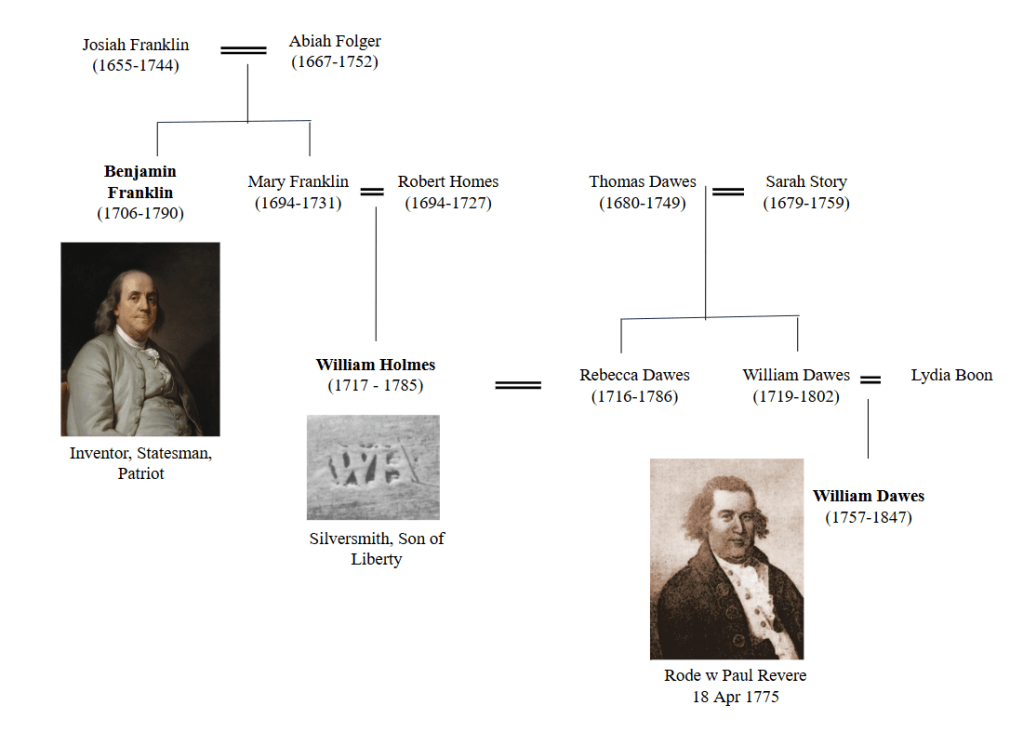
As the United States approches its 250th anniversary I have been reflecting on the life on my 7th great grandfather, William Homes. He was born at the home of his maternal grandparents, Josiah and Abiah Franklin. The occasion is wonderfully recorded in the diary of his grandfather, the Reverend William Homes of Chilmark:

My Grandson William Homes was born Jan 10 1716/17 at 2 afternoon. He was baptized in the Old North Church by Dr Increase Mather the 13th day of the same month
William’s parents, Robert Homes and Mary Franklin, had been married just nine months earlier in April 1716. We know that William was born in the Franklin home, though whether Robert and Mary were living with her parents at the time, or whether Mary simply chose to be with her family for the birth, is uncertain. Also living in the Franklin house was the ten-year-old Benjamin Franklin, the future inventor, statesman, and patriot. The house stood on the southwest corner of Union and Hanover Streets — Josiah had purchased it in 1712, moving his family from the smaller house on Milk Street where Benjamin and Mary had been born.
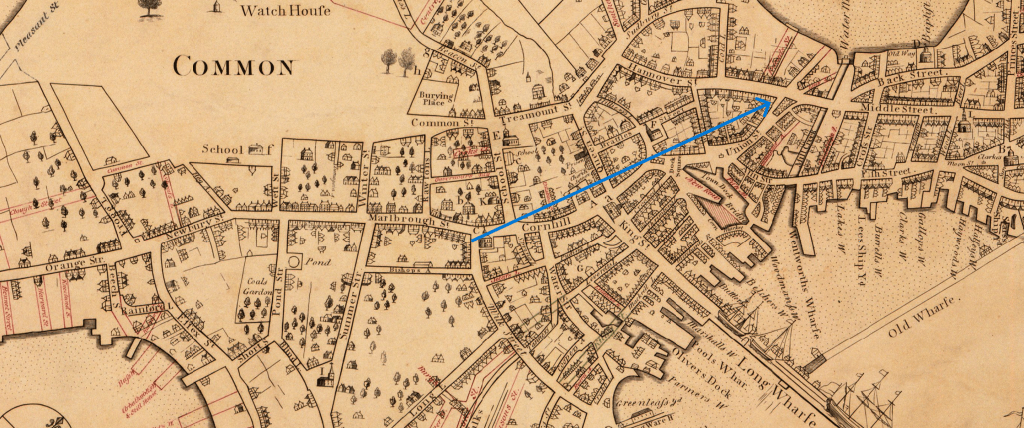
William spent much of his youth with his grandparents. His father, Robert Homes, was a mariner and often at sea, and died in 1727 when William was only ten. His mother, Mary Franklin Homes, died of breat cancer four years later in 1731. William, now fourteen and an orphan, was thereafter raised by his grandparents.
Family
William Homes and Rebecca Dawes were married on 24 April 1740 by the Reverend Joseph Sewell at the Old South Church. Rebecca was the daughter of Thomas Dawes, a local mason or bricklayer, and his wife Sarah Storey. Rebecca’s brother William was the father of William Dawes, Jr., who is famous for his midnight ride with Paul Revere on the night of April 18, 1775, warning the residents of Lexington and Concord that British soldiers were marching from Boston.
Much of what we know about the family comes from the recollections of their daughter Sarah Homes (1747–1826). Her Memoir of Mrs Sarah Tappan was published in 1834. She married one of William Homes’s apprentices, silversmith Benjamin Tappan, in 1770. Their children include Benjamin Tappan, Jr., who became a U.S. Senator from Ohio, and the famous abolitionists Arthur Tappan and Lewis Tappan. It was Lewis who in 1841 helped secure freedom for the enslaved Africans aboard the Amistad. Their descendants also include the author and playwright Thornton Wilder, a great-grandson of Arthur Tappan.
Daughter Sarah Homes Tappen states that her parents William and Rebecca had sixteen children, most of whom died young, with only 5 surviving to adulthood. Those we know about were all baptized at the Old South Church:
- Mary Homes b. 5 Mar 1740/41, bapt. 8 Mar 1740/41
- William Homes, jr b. 7 May 1742, bapt. 16 May 1742
- Thomas Homes b. 16 May 1743, bapt. 22 May 1743
- Robert Homes bapt. 2 Dec 1744/45
- Katherine Homes b. 12 Apr 1746, bapt. 13 Apr 1746
- Sarah Homes bapt. 27 Dec 1747
- Josiah Homes bapt. 3 Sep 1749
- Rebecca Homes bapt. 14 Oct 1750
- Abigail Homes bapt. 20 Oct 1754
- John Homes bapt. 17 Oct 1756
- Elizabeth Homes bapt. 3 Jun 1759
- Benjamin Franklin Homes bapt. 20 Jul 1760 (my ancestor)
Apparently William and Rebecca’s daughters didn’t need to look far for husbands. Daughter Mary Homes married another of Homes’s apprentices, Barnabas Webb.
Silversmith
As a teenager I read Johnny Tremain by Esther Forbes. It was one of my favorite books. I loved the story of the young appentice silversmith on the cusp of the American Revolution. When I later learned that my seventh great-grandfather was a silversmith during this very period, I felt an immediate connection.
William began his career as an apprentice to Rufus Greene and, according to Patricia Kane’s Colonial Massachusetts Silversmiths and Jewelers, was probably fully trained by 1738.
It seems likely that Josiah Franklin helped his grandson get started in business. When Josiah died in 1745, his estate was owed £6..2..8 from William Homes. Josiah’s will, dated 20 October 1744, left only half a share to William, with the note:
The Reason Son Holme’s Share is but half a Ninth is because I paid for him I suppose more than a half Share may come to
This note refers to Robert Homes (William’s father), whom Josiah called “Son Holme’s” — meaning his son-in-law — and reflects money Josiah had already advanced to the Homes family. The practical effect was that William received a reduced inheritance.
Homes was also left money by his grandfather, the Reverend William Homes, who died in June 1746.
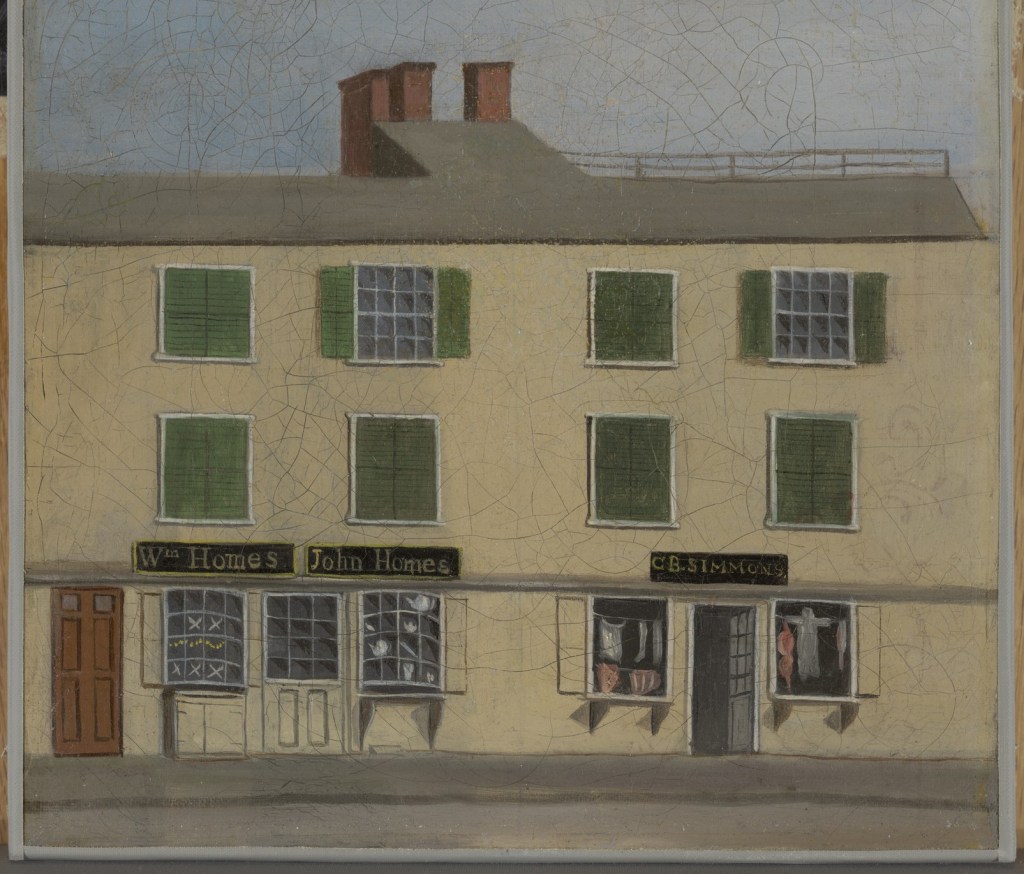
By August of that year, Homes was well enough established to purchase a house and shop on Ann Street from a shopkeeper, Samuel Gardner, for £1,050. The deed described the property as occupied by “James Butler Goldsmith and others containing Cellar, Shop, Low Room, Chamber and Garrett.” In September, Homes improved the property with an addition to the west side of the house, receiving permission from his neighbor Charles Coffin to attach a roof to the adjacent building. This property would remain in the family for over half a century, eventually passing to his sons.
The painting below by an annonymous painter shows the shop as it looked in the early 1800s.
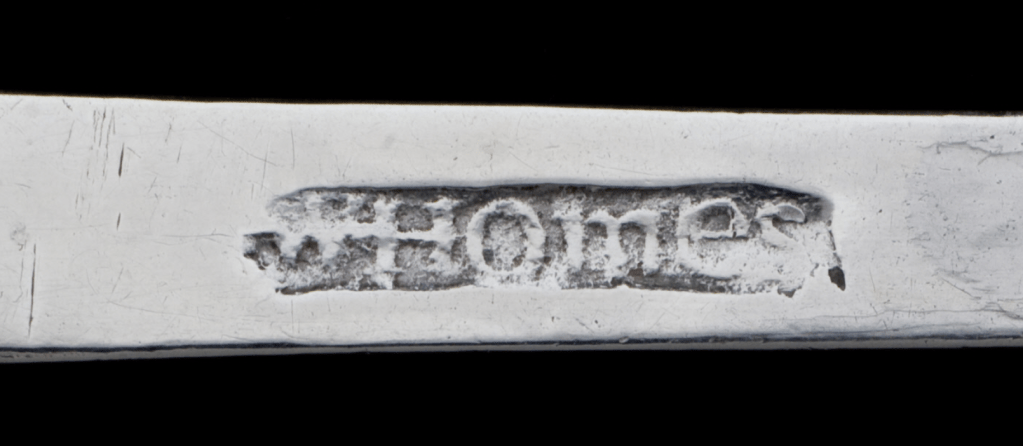
Homes was of course a contemporary and competitor of the celebrated Boston silversmith Paul Revere. He was fairly prolific, and many examples of his work survive today in the collections of the Museum of Fine Arts, Boston; the Henry Francis du Pont Winterthur Museum; the Yale University Art Gallery; and the Cleveland Museum of Art, among others.
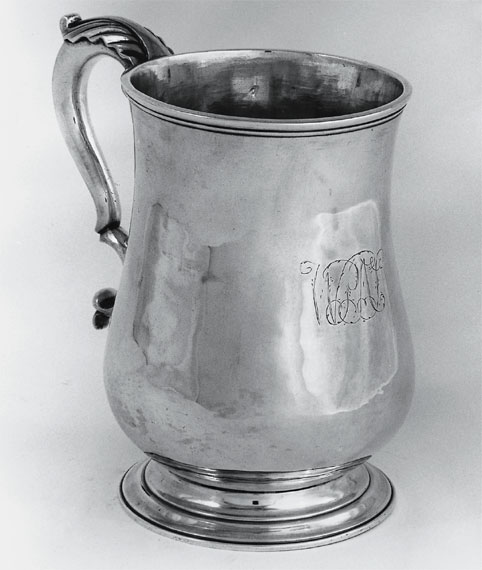
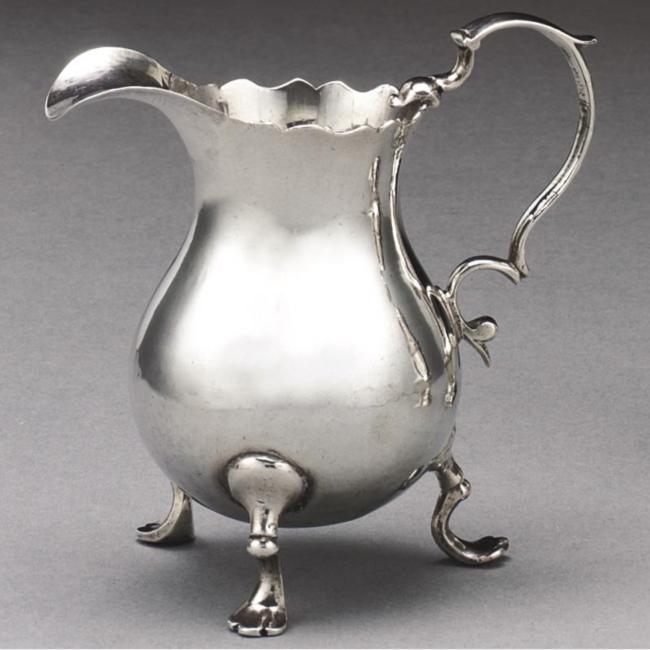
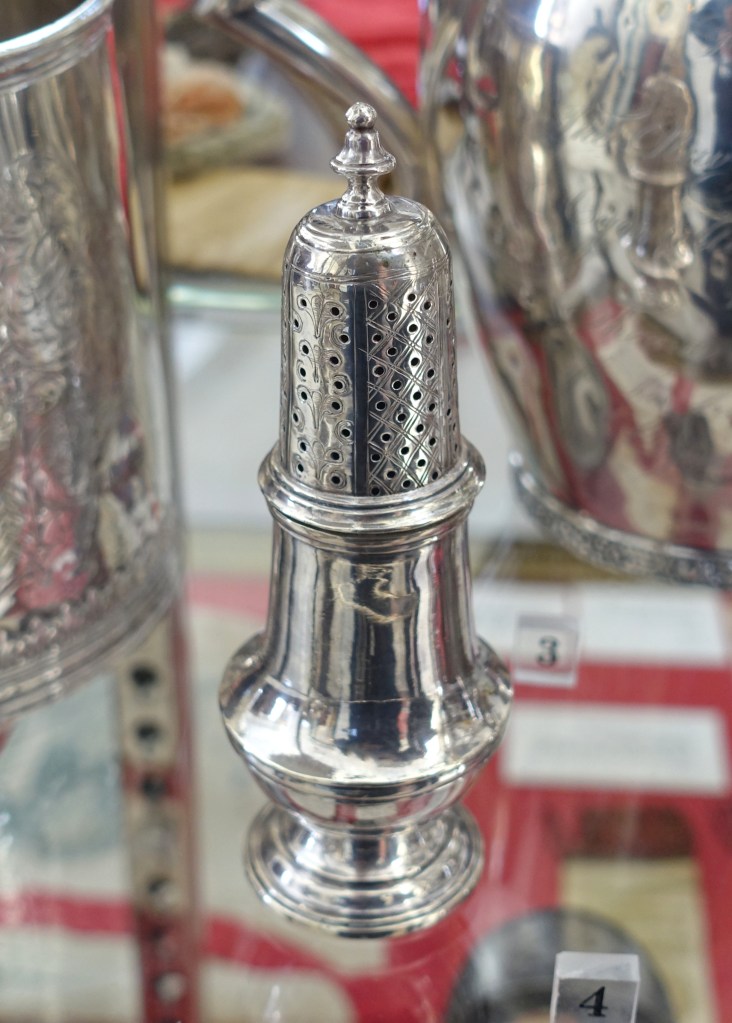
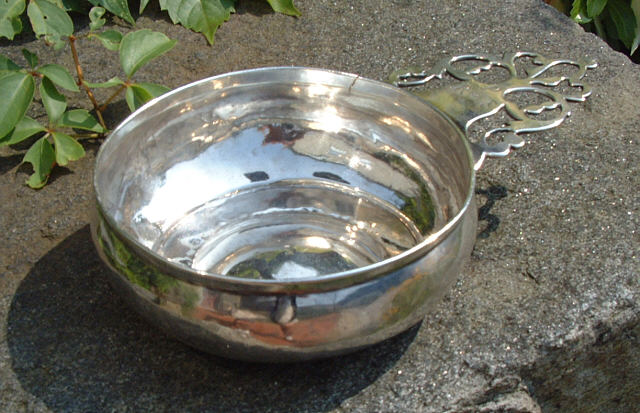
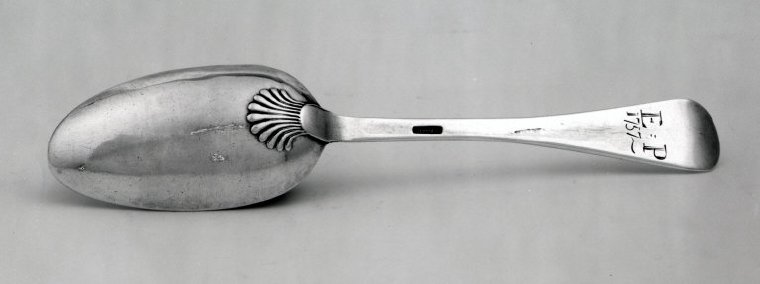
According to the memoir of his daughter Sarah Tappan, William turned over the day-to-day operation of the silver shop to his son William Homes, Jr. in 1763, once the younger man had completed his training. From that point, William, Sr. concentrated increasingly on mercantile trade.
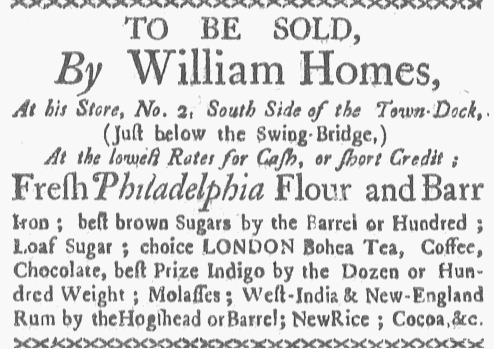
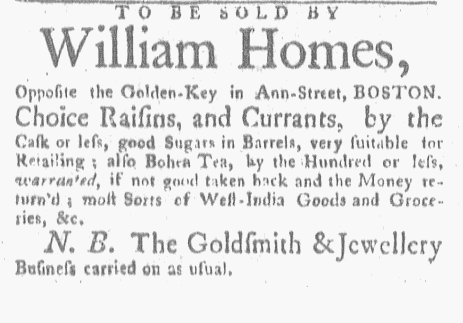
Homes was reputedly very pious. He is remembered for refusing to let his ship leave port on the Sabbath, even when competitors took advantage of favorable winds. According to daughter Sarah, this decision proved wise, as his ship arrived in port days ahead of others that had been blown off course or met with other mishaps.
Civic Life and Military Service
Homes was also active in the civic and military affairs of Boston. He joined the Ancient and Honorable Artillery Company — Boston’s voluntary militia — on 5 September 1747. He was elected First Sergeant in 1752, Fourth Sergeant in 1754, Lieutenant in 1761, and Captain in 1765. He would be known as Captain William Homes in most public records from that time forward.
He held numerous public offices: Clerk of the Market in 1753, 1754, and 1763; Warden in 1764; Purchaser of Grain from 1766 through 1770; Surveyor of Highways from 1767 through 1769; and Fire Warden from 1764 or 1770. He also served on various town committees between 1762 and 1770, including committees to enforce non-importation agreements, inspect the town and public schools, and settle land disputes involving eminent domain.
Son of Liberty
William Homes was not a famous revolutionary, but like many Bostonians he was gradually won over to the cause of independence. His name appears on the list of three hundred Sons of Liberty who dined at the Liberty Tree Tavern in Dorchester on 14 August 1769, celebrating the fourth anniversary of the Stamp Act protests. The Massachusetts Historical Society describes the occasion:
In 1769, according to newspaper accounts, an enormous throng gathered again at the Liberty Tree in Boston where, at 11:00 AM, they drank fourteen toasts and then “repaired” to the “Liberty-Tree-Tavern,” … where 300 of 355 present dined together under a tent pitched for the purpose, with “a variety of colours” (flags) flying. They were entertained with music, including John Dickinson’s “Liberty Song,” “mimickry” by Nathaniel Balch, the firing of cannon, and after dinner had forty-five more toasts. …
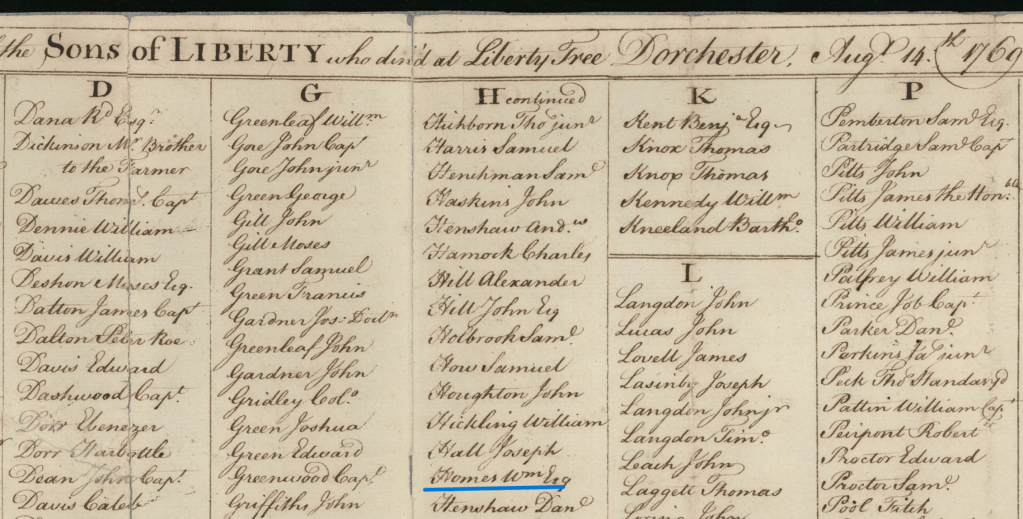
John Adams, who was present, reportedly remarked on the temperance of the participants. William Homes, Esq. is recorded among the attendees on the list compiled by Colonel William Palfrey, which also includes such prominent patriots as John Adams, Samuel Adams, and John Hancock. The complete list can be viewed online.
In May 1770, Homes purchased a 135-acre farm approximately thirty miles south of Boston in the town of Norton, and an adjoining farm of another 135 acres the following month. A History of the Town of Norton suggests he may have been “driven [from Boston], in 1770, on account of his hostility to the despotic acts of the British government” — a characterization that is likely somewhat romanticized, though the escalating tensions in Boston were undoubtedly a factor in the decision.
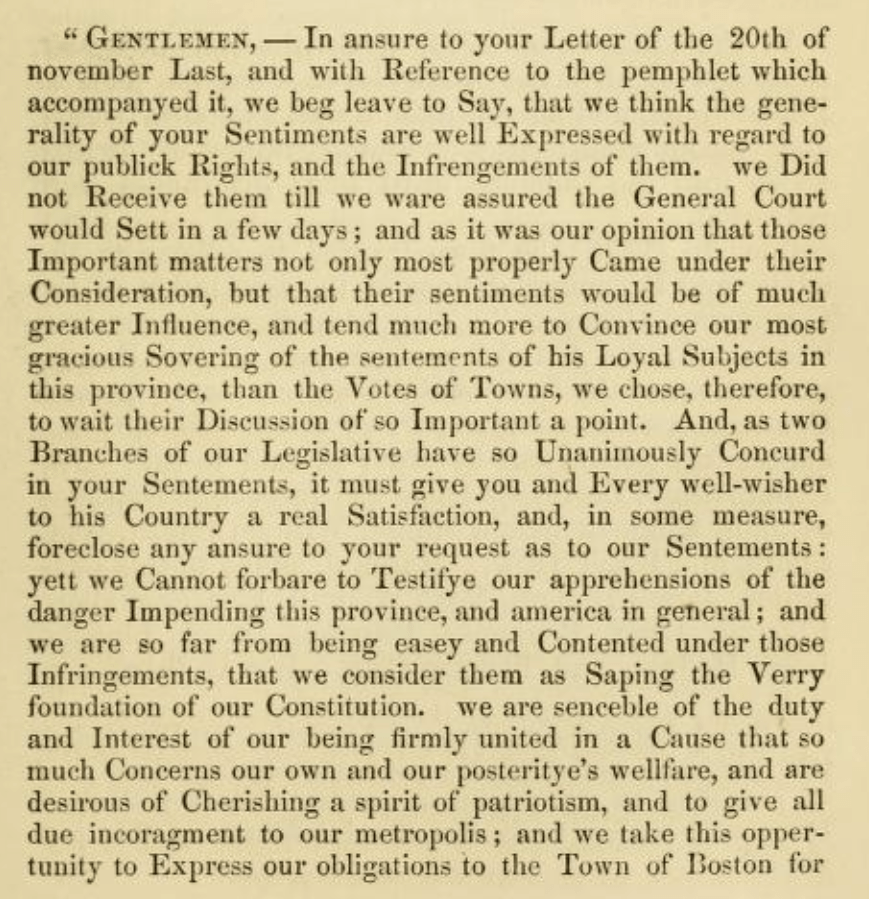
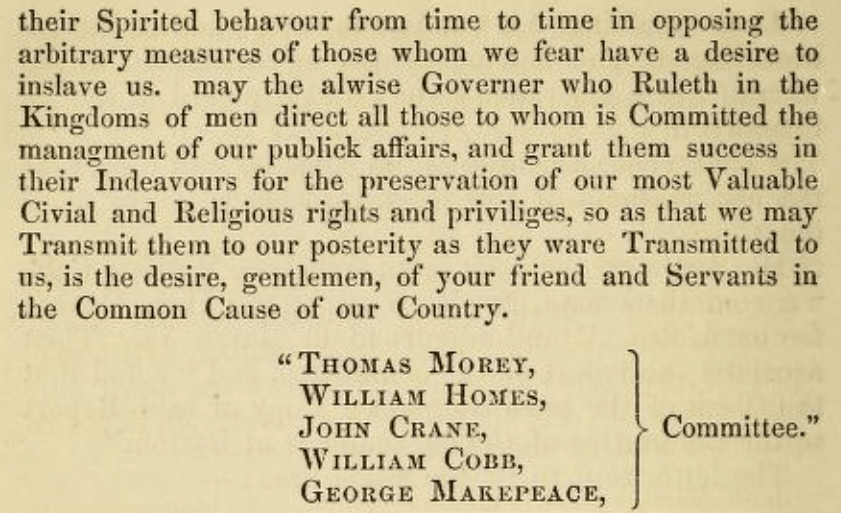
In January 1773, Boston sent a petition requesting support from neighboring towns. The town of Norton met to consider “the many incroachments made of late on our most valuable Rights and priviledges, and the several Infringements and violations of the just Rights of this province.” The town appointed a committee, including William Homes, to review the matter. After deliberation, Norton wrote to Boston affirming their solidarity:
We take this opportunity to express our obligations to the Town of Boston for their Spirited behavour from time to time in opposing the arbitrary measures of those whom we fear have a desire to inslave us.
Provincial Congress
The situation continued to escalate. In October 1774, Governor Thomas Gage dissolved the provincial assembly. The members reconvened anyway and organizing themselves as the Massachusetts Provincial Congress on 7 October 1774. With John Hancock as its president, this extralegal body became the de facto government of Massachusetts outside of Boston — the first autonomous government in the Thirteen Colonies.
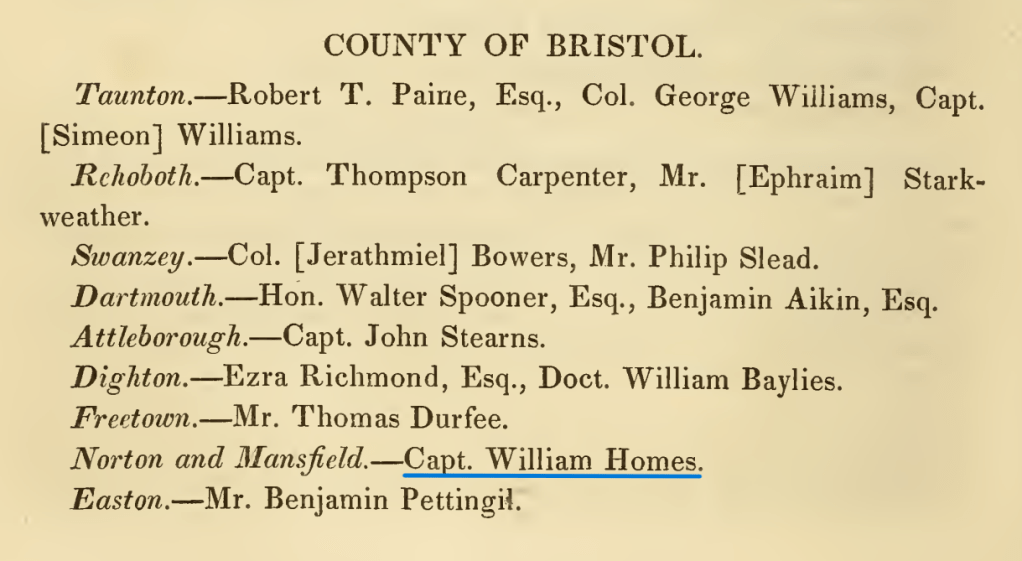
This First Provincial Congress dissolved in early December with plans to reconvene on 1 February 1775. When it did, Captain William Homes was selected to represent the towns of Norton and Mansfield.
The Provincial Congress faced the full range of challenges confronting a wartime government. Captain Homes served on numerous committees, dealing with matters including:
- Steps necessary for assisting the poor of Boston
- The interception of letters bearing intelligence to the enemy
- Means of furnishing those in the Massachusetts army who were without arms
- Creating and printing a new legal currency
- The examination of Ensign Robert Campbell, lately arrived from England and held as a prisoner
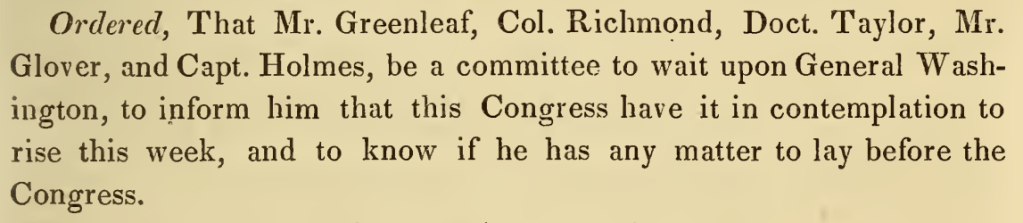
- Waiting upon General Washington to inform him of the Congress’s schedule and to learn if he had matters to lay before them
- Methods to prevent intelligence reaching the enemy and to stop the supply of provisions to them
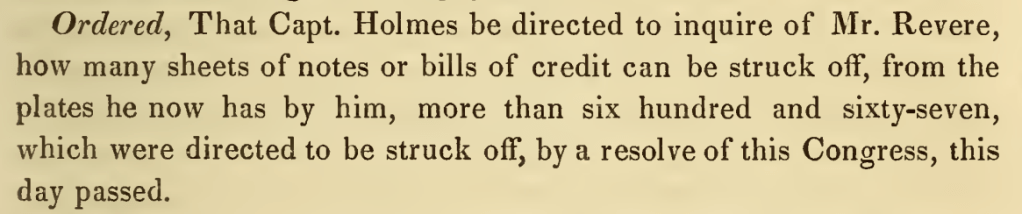
Homes paid a fine in lieu of military service during the draft of 1776 — a decision almost certainly influenced by his age, as he was sixty years old at the time. He did, however, serve on Norton’s Committee of Correspondence throughout the war. These committees were the principal organizations coordinating opposition to Great Britain, and they largely directed the revolutionary effort at the state and local level.
Final Years
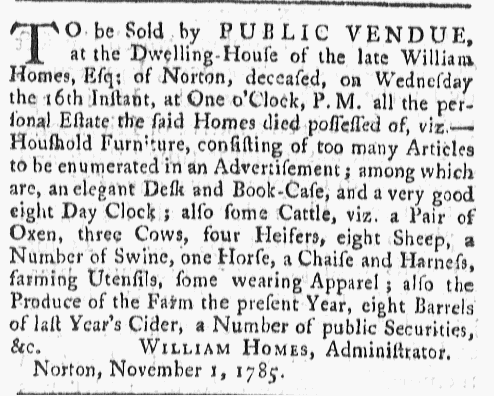
After 1776, the fighting moved south and Homes life resumed a more normal pace. He spent his final years serving as Justice of the Peace for Bristol County. Fighting ended in 1781. Independence for the new nation was won. A formal peace treaty was signed in October 1783, but Homes had little time to enjoy the peace. He contracted dysentery on a visit to Boston and died there on 21 June 1785. His properties in Norton were sold to settle debts owed by his estate.
Final Thoughts
William Homes lived in remarkable times. He was a successful silversmith and merchant, a civic leader, a militia officer, and — in his own measured way — a patriot. He was not celebrated like his uncle Benjamin Franklin, but his life illustrates how the American Revolution was sustained not only by its famous figures but by the hundreds of capable, principled men who served on committees, signed petitions, attended meetings, and quietly organized a new nation.
References
Colonial Massachusetts Silversmiths and Jewelers: A Biographical Dictionary, Patricia Kane, Yale University Art Gallery, 1996
Franklin’s Father Josiah: Life of a Colonial Boston Tallow Chandler, Nian-Sheng Huang, American Philosophical Society, 2000
Baptismal records, 1669-1875, Old South Church in Boston, Mass.
Memoir of Mrs Sarah Tappan, 1828
Life of Arthur Tappan, Lewis Tappan, 1870
Yankee Family, James McGovern, New Orleans, 1975, p.12
An Alphabetical List of the Sons of Liberty who din’d at Liberty Tree, Dorchester, Col. William Palfrey, 14 August 1769 at Massachusetss Historical Society
The journals of each Provincial congress of Massachusetts in 1774 and 1775, 1838


 Holmes Genealogy
Leave a comment