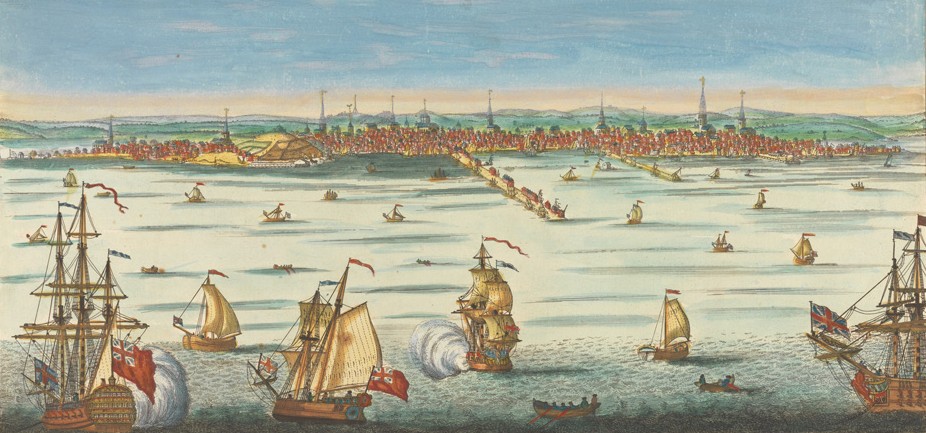
My 8th great grandfather, Robert Homes, has fascinated me since I first learned of him – a sea captain and a brother-in-law to Benjamin Franklin! It doesn’t get much better for an amateur family historian.
Our first record of Robert is wonderfully preserved in the diary of his father, Reverend William Homes.1
![Robert Homes was born July the 23d 1694 being Monday at 12 of the clock in the day time, In Stragolan [Stragullin]and was baptized the Wednesday following, in my own house by Mr Robert Craghead, his grandfather.](https://holmes-history.com/wp-content/uploads/2026/03/robert-homes-b1694.png?w=1024)
My Son Robert Homes was born July the 23d 1694 being Monday at 12 of the clock in the day time, In Stragolan [Stragullin]and was baptized the Wednesday following, in my own house by Mr Robert Craghead, his grandfather.
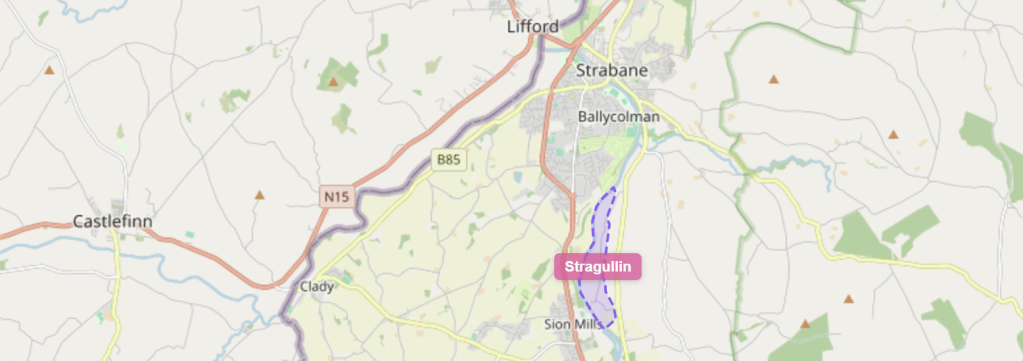
Stragullin is a narrow townland bordering the Mourne River just south of Strabane, co Tyrone, Ireland.
Leading the way
Robert pursued a maritime career, making repeated voyages between New England and Ireland. It is often said that he arrived in Boston with his father on the Mary and Jane in October 1714, but recent research shows that he in fact preceded his family to New England. In November 1712, Robert set sail from Loch Indaal in Scotland for Barbados, and eventually on to America. This voyage was recorded in some detail by the Rev William Homes in his diary. The voyage was plagued from start with several days of severe winds. The ship then sprung a leak and they were forced to put into Lough Swilly in Ireland for repairs. This wasn’t all bad however as the stop in Ramelton gave Robert a chance to meet with his father.
on Monday I went down towards the ship and Tuesday meet with my Son at Ramelton. I came that night back to Ramelton had my son along with me.
Repairs were made and the voyage continued. On April 28 1713, his father had received an account “that the ship wherin my Son Robert went passenger was safe in Barbados.”
By November 1713 Robert was in Boston and sufficiently established to witness a significant property transaction (see below) and on March 14, 1714 he was admitted to the Old North Church.2,3
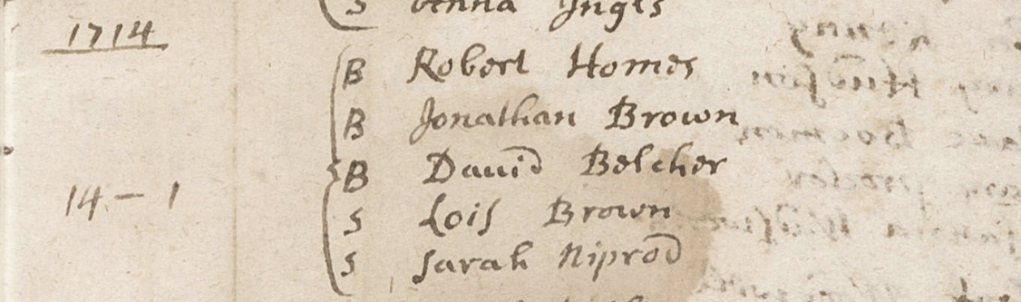
That summer Robert visited Martha’s Vineyard. He is mentioned in the diary of Samuel Sewall. 4
July 5. 1714. Major Thaxter and I went to the Gay Head, accompanied by Mr. Thomas Mayhew, Mr. Josiah Torrey, Mr. Ebenezer Allan, Mr. Robert Catlhcart, Mr. Benjamin Haws, Mr. John Denison, Mr. Robert Homes, David Sinclar. Major Skiff, and Mr. Experience Mayhew.
It appears that Robert came in advance to make preparations for his family’s move to America. They would arrive in October of 1714 on the Mary & Jane.5 The Rev William Homes and the rest of the family would settle at Chilmark on Martha’s Vineyard while Robert remained in Boston. Also on board was Robert’s uncle, the Rev Thomas Craighead who would settle in Freetown, MA before moving on to Delaware and eventually Pennsylvania. Robert would witness a deed for him in 1717.6
1718 Migration
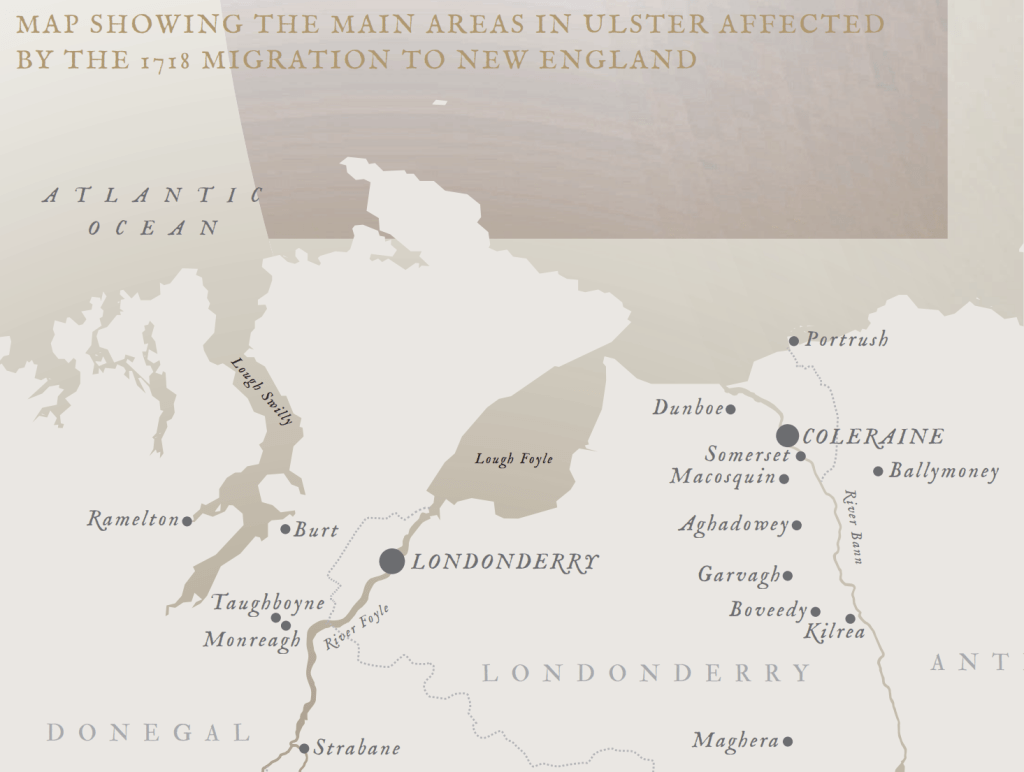
The year 1718 saw one of the largest organized emigrations of Scotch-Irish Presbyterians to New England.7 Driven by increased rents, the Test Act’s religious discrimination against non-conformists, and persistent economic hardship in Ulster, several thousand people emigrated between 1717 and 1720, establishing the communities of Londonderry in New Hampshire, Worcester in Massachusetts, and settlements along the Maine coast. The movement was not spontaneous: it was deliberately organized, and it required agents operating on both sides of the Atlantic.
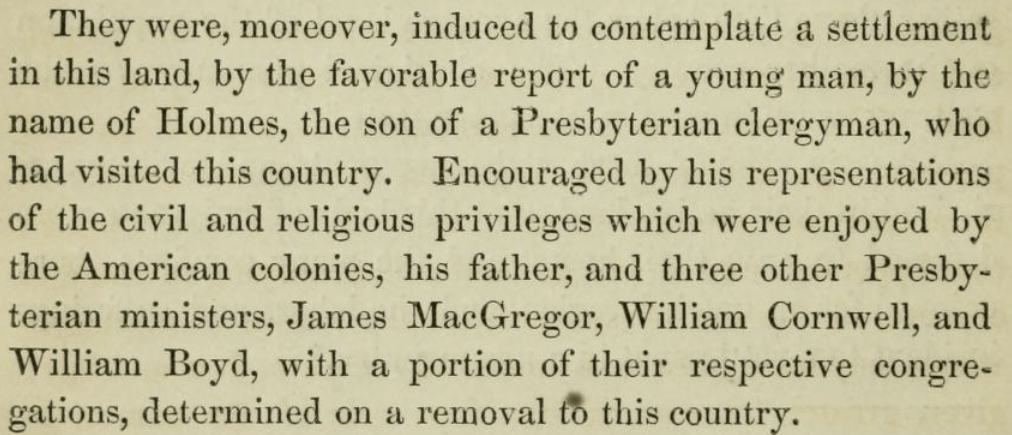
In his book Scotch-Irish Pioneers in Ulster and America, Charles Knowles Bolton states that in November 1717, the Revered William Homes was in communication with Cotton Mather, his son Robert, and land speculators anxious to develop the area along the Kennebec River in Maine. It has been suggested this correspondence was followed by a meeting in Boston at which Robert Homes, Cotton Mather, and the Kennebec speculators agreed to transport colonists from Ulster. 8 This is supported by Edward Parker’s History of Londonderry, NH9 which states that the first settlers were “induced to contemplate a settlement in this land, by the favorable report of a young man, by the name of Holmes, the son of a Presbyterian clergyman“
Robert’s involvement began as early as 1713 when he witnessed a deed between Anne Cotton and her cousin John Watts.10 Anne had inherited significant land from her father, Captain Thomas Lake (c.1615 – 14 August 1676). Lake was a prominent Boston merchant who had purchased a half-interest in Arrowsic Island, at the mouth of the Kennebec River, as early as 1654. Anne was selling the various tracts inherited from her father to John Watts who was starting to acquire land in Maine for speculation. (Note: Anne Cotton would marry Increase Mather the following year, thus becoming the step-mother of Cotton Mather.)
On 5 September 1714 John Watts became one of the eight founding Pejepscot Proprietors — a company of Boston merchants formed specifically to develop and settle the Kennebec and Merrymeeting Bay territory. Watts had just acquired a family interest in precisely this land. He became the most active of the Proprietors, personally settling twenty families on Arrowsic Island before his death there in November 1717.
The 1713 transaction was therefore a family land transfer, with Robert Homes serving as witness to a document that carried the Lake family’s Kennebec land inheritance directly to a man who would become the most active of the Pejepscot Proprietors. Robert was already embedded in this network before the company formally existed.
The eight original Pejepscot Proprietors, all Boston merchants, were: Thomas Hutchinson (whose grandfather had purchased Saco lands in 1673 and whose brother Edward served on the Committee of Eastern Claims); Adam Winthrop (great-grandson of the first Massachusetts governor); John Watts (the hands-on settler, died 1717 in Maine); David Jeffries (wealthy merchant representing London firms, probable financial backer); Stephen Minot (tailor to militia captain, maintained the Wells-Brunswick road and transported soldiers to the Brunswick fort); Oliver Noyes (physician, Harvard 1695, selectman, married Anne Belcher, sister of Governor Jonathan Belcher); John Ruck (brother-in-law of Thomas Hutchinson and father-in-law of the future Governor Benning Wentworth); and John Wentworth of Portsmouth, New Hampshire (Surveyor of the King’s Woods, Lieutenant Governor 1717–1730).
By November 1717 plans for the migration were well underway. On 24 November 1717, Rev. William Homes recorded. “I received Severall letters two from Doctor Cotton Mather, one from Several gentlemen proprietors of lands at a near to Casco Bay, and one from Son Robert.” These “gentlemen proprietors” are almost certainly The Pejepscot Proprietors who held extensive lands in the Merrymeeting Bay and Kennebec River region of Maine.
Five Voyages
The 1718 Voyage
Robert departed for Ireland on April 1718 as recorded in his father’s diary: “my Son Robert Homes Set Sail for Ireland on Tuesday last.”
Robert was back in Boston by October 26 when Rev Homes diary records “Mr Homin told me after Sermon that Mr Miller told him that on Monday last that my son Robert was Safe arrived from Ireland full of passengers.” The Boston News-Letter of 27 October 1718 records “Alexander Miller Ship Mary and Elizabeth from Londonderry” entering inwards. This is the only documented Ireland arrival in that edition, and the timing matches the diary entry. Miller’s departure for Ireland in April also matches, so we are relatively sure that Robert was on the Mary and Elizabeth. His precise role on the 1718 voyage is uncertain. He may have been a mate, or acting as agent or supercargo, but we are not sure. Regardless, he seems to have been aboard the Mary and Elizabeth. This was one of the famous “five ships” which arrived in Boston that summer and fall:
- WILLIAM AND ELIZABETH, Captain John Wilson, arrived in Boston with passengers from Londonderry on 29 July 1718
- WILLIAM AND MARY, a snow, Captain James Montgomery, arrived in Boston from Coleraine or Portrush, Ireland with passengers on 25 July 1718
- WILLIAM, Captain Archibald Hunter, arrived in Boston from Coleraine with passengers on 4 August 1718
- MACCALLUM, Captain James Law, arrived in Boston from Londonderry with 100 passengers on 2 September 1718
- MARY AND ELIZABETH, 45 tons, Captain Alexander Miller, arrived in Boston from Londonderry with 100 passengers in October 1718
It was an extraordinary occasion and William soon headed to Boston.
November 11th, 1718: I Set out for Boston in Company with Mr Experience Mayhew and had a safe passage over the sound and lodged that night in Mr Lothrops in Swanescot, the Next night in Mr Littles of Plimoth, next night at Mr Williams of Roxbury and next night at my sons
November 16, 1718: I preached the in the Old North meeting house for doctor Cotton Mather from phil: 1 :21 To me to live in Christ
November 23, 1718: I preached in the new North meeting house for Mr Web from pro 12:26 The righteous is more excellent than his neighbour
The 1719 Voyage: Ship Elizabeth
Robert’s 1719 voyage is the best documented of the three. He sailed as master of the ship Elizabeth, arriving in Boston in November 1719 with a complement of passengers, some of whom had contracted smallpox during the crossing.
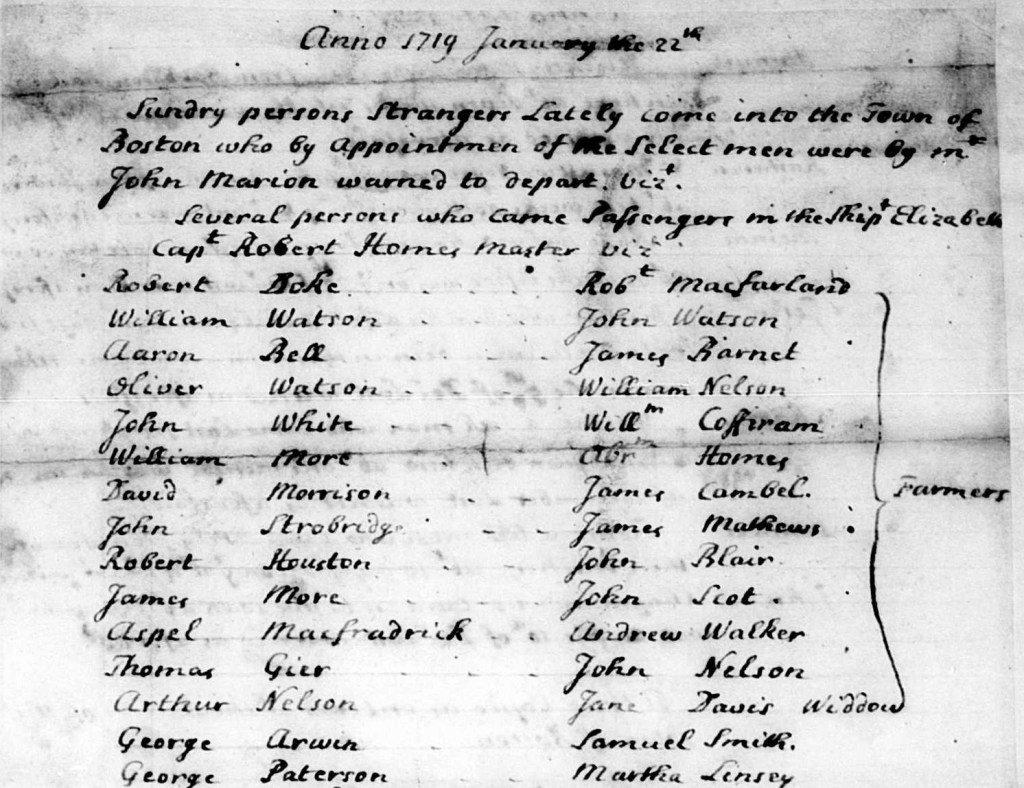
On 3 November 1719 the Boston Selectmen formally warned out the Elizabeth’s passengers as “Sundry persons Strangers Lately come into the Town of Boston.”This warning-out order — preserved in both the Suffolk County Court Files11 and the published Boston Selectmen’s Minutes 1719–20, p. 63, entry [115]12 — names “Capt. Robert Homes Master” explicitly and provides a full passenger list of thirty individuals, all designated as Farmers: Robert Doke, William Watson, Aaron Bell, Oliver Watson, John White, William More, David Morrison, John Strobridge, Robert Houston, James More, Aspel Macfradrick, Thomas Gier, Arthur Nelson, George Arwin, George Paterson, Robert Macfarland, John Watson, James Barnet, William Nelson, Will’m Coffiram, Abr’m Homes, James Cambell, James Mathews, John Blair, John Scot, Andrew Walker, John Nelson, Jane Davis Widdow, Samuel Smith, Martha Linsey.
One passenger warrants particular attention: “Abr’m Homes” or Abraham Homes. This is almost certainly Abraham Holmes from Aghadowey. He brought with him a very interesting letter from the church in Aghadowey, Ireland which was printed in Bolton’s book.13
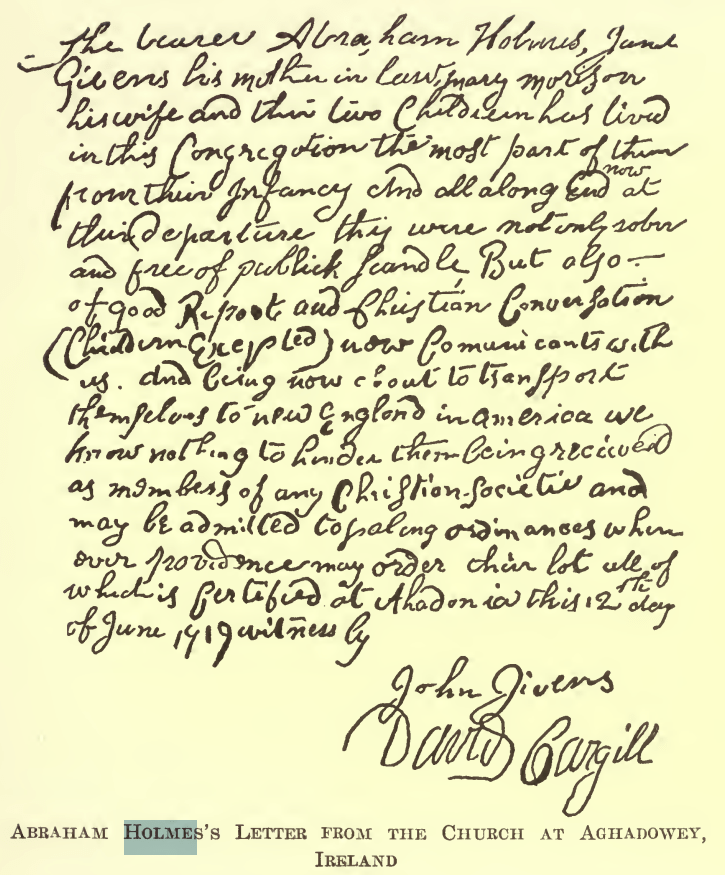
Abraham would become one of the charter settlers of Nutfield, later Londonderry or Derry, NH
The 1720 Voyage
We know little of this voyage. Robert was in Chilmark on Martha’s Vineyard in February when he left for Boston and he was back by Sept 4 when Rev Homes records “I had an account yesterday of my Son Roberts safe arrivall in Boston from Ireland.” A good son, he was out to visit his father at Chilmark the following week, staying until 3 October 1720. Robert does not appear by name in the newspaper shipping reports for the year.
The 1721 Voyage
Robert left Boston in the fall of 1720 to go to Ireland, a potentially dangerous time for a crossing, but he arrived safely and was in Cork in January. The voyage appears to have been difficult and one that filled his father with anxiety as we can see from his diary entries:
14 May 1721: We have had no news of son Roberts return from Ireland
21 May 1721: there is yet no news from son Robert
28 May 1721: there is yet no news from son Robert
4 Jun 1721: we have yet had no account of son Robert
11 Jun 1721: as yet no news of Son Roberts return
18 Jun 1721: we received a letter from son Robert dated at Cork in Ireland Janr 31
2 Jul 1721: We have yet had no account of Son Roberts return home
9 Jul 1721: We have yet had no account of son Roberts arrival. The small pox I understand, prevails in Boston
16 Jul 1721: We have yet had no news from son Robert, neither have I heard any thing from John since he went abroad
23 Jul 1721: We have yet had no account of son Roberts arrival neither have we had any words from son John my wife Continues still much indisposed, I have also been for some time indisposed with a flux
30 July 1721: we have not yet had any account of son Roberts arrival
6 Aug 1721: we have yet no news of son Roberts arrival, my wife Continues much indisposed
13 Aug 1721: We have as yet heard nothing of son Robert arrivall. my wife still Continues indisposed.
20 Aug 1721: no news yet of son Roberts arrival
27 Aug 1721: we have yet heard no account of son Roberts arrival, my wife Continues still much indisposed
3 Sep 1721: We have had no news as yet of son Roberts arrival, my wife Continues still much indisposed.
10 Sep 1721: I have as yet had no account of son Roberts arrival
24 Sep 1721: we have had yet no news of son Roberts arrival
1 Oct 1721: we have yet no account of son Roberts arrival
8 Oct 1721: no news as yet of son Robert arrival
15 Oct 1721: we have as yet heard nothing of Son Roberts arrival. My wife Continues to keep her bed
22 Oct 1721: I have as yet heard nothing of Son Roberts arrivall, I had an account from John that he was come Safe to Plimoth. my wife still keeps her bed
29 Oct 1721: I have heard nothing as yet of Son Roberts arrivall: my wife Continues yet much Indisposed
5 Nov 1721: I have as yet had no account of son Roberts arrivall, my wife is easy tho still confined to her bed
12 Nov 1721: I had an account that son Robert was arrived in Boston for which & all other his mercies I desire to bless God
19 Oct 1721: I had a letter from son Robert dated in Boston the 15 Instant, he has made but a bad voyage of it
The 1722 Voyage – Shipwreck
After what was a difficult 1721 voyage, we can imagine that Robert may not have been looking forward to another crossing, but he was reported outward bound for Great Britain in May 1722. Perhaps they had problems and needed to return for he is again reported outward for Great Britain in Jun 1722.
It was to be another difficult voyage. On December 9, 1722 he was returning from Ireland with about 100 passengers when the ship ran aground near Manasquan, NJ about 14 or 15 miles south of Sandy Hook. He and all the people were saved but the vessel was lost.
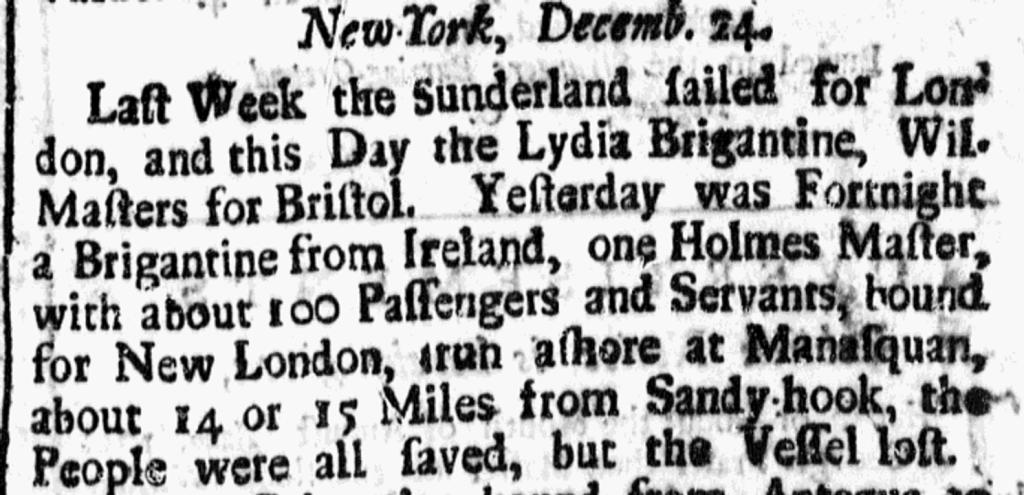
This was subsequently confirmed by a letter from Robert to his father dated in New York, January 4, wherein he wrote that he had suffered shipwreck on the coast of New Jersey on the 9th of December, but lost only the hull of the vessel. This transatlantic voyage seems to have been enough for Homes. It was his last. From that point on he restricted himself to voyages to running up and down the Atlantic coast.
Marriage and Family
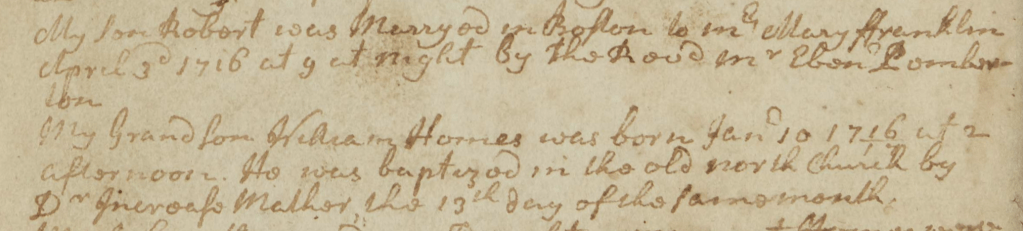
According to the diary of Rev William Homes, “My Son Robert was Marryed in Boston to Miss Mary Franklin April 3d 1716 at 9 at night by the Revd Mr Ebenezer Pemberton. “
Mary Franklin was born on 26 September 1694 in Boston. She was the sister of the famous statesman Benjamin Franklin. Of course, Benjamin Franklin wasn’t famous when Robert married his sister Mary. Benjamin was only 10 and Franklin’s father, Josiah Franklin, was a simple tallow chandler, working hard to support a large family by making soap and candles.
Mary Franklin and her brother Benjamin were two of Josiah’s seventeen children with his two wives. He married his first wife, Anne Child, in about 1677 in Ecton, England and emigrated with her to Boston in 1683; they had three children before emigration and four after. Following her death, Josiah married Abiah Folger on July 9, 1689, and had ten children with her including Mary and Benjamin.
Robert and Mary wasted no time starting a family for their first child, William was born 9 months later on January 10, 1716/17. A daughter Abiah followed two years later. Robert would have 3 children in all
- William Homes b.10 Jan 1716/17. Married Rebecca Dawes. Died 21 Jan 1785 on a visit to Boston.
- Abiah b. 14 Dec 1719. Died 3 Aug 1729
- Robert – mentioned in his grandfather’s will. Died abt. 1744 in England
Benjamin Franklin’s Autobiography
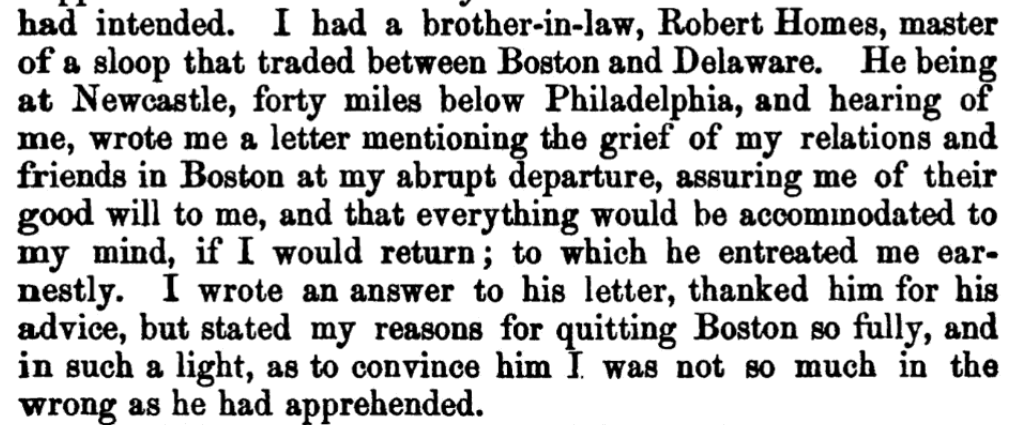
Robert appears in Franklin’s Autobiography: “I had a Brother-in-law, Robert Homes, Master of a Sloop, that traded between Boston and Delaware. He being at Newcastle 40 Miles below Philadelphia, heard there of me, and wrote me a Letter, mentioning the Concern of my Friends in Boston at my abrupt Departure, assuring me of their Good Will.“14
In hindsight this encounter seems providential. When Franklin wrote an elegant letter back explaining why he would not return to Boston, Homes showed the letter to Pennsylvania Governor William Keith, who was moved by Franklin’s strong writing skills. Keith resolved to help Franklin set up a printing house. In other words, Robert Homes was inadvertently responsible for setting Benjamin Franklin on the path to his career as a printer and public figure in Philadelphia.
Given that it is the most famous event in Robert Homes life I will quote Franklin’s autobiography at some length.
I had a brother-in-law, Robert Homes, master of a sloop that traded between Boston and Delaware. He being at Newcastle, forty miles below Philadelphia, and hearing of me, wrote me a letter mentioning the grief of my relations and friends in Boston at my abrupt departure, assuring me of their good will to me, and that everything would be accommodated to my mind, if I would return; to which he entreated me earnestly. I wrote an answer to his letter, thanked him for his advice, but stated my reasons for quitting Boston so fully, and in such a light, as to convince him I was not so much in the wrong as he had apprehended.
Sir William Keith, governor of the province, was then at Newcastle, and Captain Homes, happening to be in company with him when my letter came to hand, spoke to him of me, and showed him the letter. The governor read it, and seemed surprised when he was told my age. He said I appeared a young man of promising parts, and therefore should be encouraged; the printers at Philadelphia were wretched ones; and, if I would set up there, he made no doubt I should succeed; for his part, he would procure me the public business, and do me every other service in his power. This my brother-in-law, Homes, afterwards told me in Boston; but I knew as yet nothing of it;…
… the governor inquired for me, came up, and, with a condescension and politeness I had been quite unused to, made me many compliments, desired to be acquainted with me, blamed me kindly for not having made myself known to him when I first came to the place, and would have me away with him to the tavern, … I went …with the governor and … he proposed my setting up my business. He stated the probabilities of my success, and .. assured me I should have their interest and influence to obtain for me the public business of both governments. And, as I expressed doubts that my father would assist me in it, Sir William said he would give me a letter to him, in which he would set forth the advantages, and he did not doubt he should determine him to comply. So it was concluded I should return to Boston by the first vessel, with the governor’s letter to my father. …
About the end of April 1724, a little vessel offered for Boston… The governor gave me an ample letter, saying many flattering things of me to my father, and strongly recommending the project of my setting up at Philadelphia, as a thing that would make my fortune. …We arrived safe, however, at Boston, in about a fortnight. I had been absent seven months, and my friends had heard nothing of me; for my brother Homes was not yet returned, and had not written about me. My unexpected appearance surprised the family; all were, however, very glad to see me, and made me welcome, except my brother. I went to see him at his printing-house. I was better dressed than ever while in his service, having a genteel new suit from head to foot, a watch, and my pockets lined with near five pounds sterling in silver. He received me not very frankly, looked me all over, and turned to his work again….
My father received the governor’s letter with some surprise, but said little of it to me for some time. Captain Homes returning, he showed it to him, and asked him if he knew Sir William Keith, and what kind of man he was; adding that he must be of small discretion, to think of setting a youth up in business who wanted three years to arrive at man’s estate. Homes said what he could in favor of the project, but my father was decidedly against it, and at last gave a flat denial. He wrote a civil letter to Sir William, thanking him for the patronage he had so kindly offered me, and declining to assist me as yet in setting up, I being in his opinion too young to be trusted with the management of an undertaking so important, and for which the preparation required a considerable expenditure…
My father, though he did not approve Sir William’s proposition, was yet pleased that I had been able to obtain so advantageous a character from a person of such note where I had resided, and that I had been so industrious and careful as to equip myself so handsomely in so short a time; therefore, seeing no prospect of an accommodation between my brother and me, he gave his consent to my returning again to Philadelphia advised me to behave respectfully to the people there, endeavor to obtain the general esteem, and avoid lampooning and libeling, to which he thought I had too much inclination; telling me that by steady industry and prudent parsimony I might save enough, by the time I was one-and-twenty, to set me up; and that if I came near the matter he would help me out with the rest. This was all I could obtain, except some small gifts as tokens of his and my mother’s love, when I embarked again for New York; now with their approbation and their blessing.
The sloop putting in at Newport, Rhode Island, I visited my brother John, who had been married and settled there some years. He received me very affectionately, for he always loved me. A friend of his, one Vernon, having some money due to him in Pennsylvania, about thirty-five pounds currency, desired I would recover it for him, and keep it till I had his directions what to employ it in. Accordingly he gave me an order to receive it. This business afterwards occasioned me a good deal of uneasiness.
[Franklin discusses taking charge of some money to be forwarded to a Mr Vernon. Franklin strapped for cash spends some of the money with the intent to repay it.]
The violation of my trust respecting Vernon’s money was one of the first great errata of my life; and this showed that my father was not much out in his judgment, when he considered me as too young to manage business. But Sir William, on reading his letter, said he was too prudent, that there was a great difference in persons; and discretion did not always accompany years, nor was youth always without it. “But, since he will not set you up, I will do it myself. Give me an inventory of the things necessary to be had from England, and I will send for them. You shall repay me when you are able; I am resolved to have a good printer here, and I am sure you must succeed.”
Selling the sloop and subsequent deaths
Two years later Robert appears to have reached the end of his nautical career. On 15 May 1726 Rev William states in diary “I heard this day from son Robert and understand that he has sold his sloop and designs to settle on shore and leave off the sea” Unfortunately the only further entry in the diary is dated October 22, 1727, his father states, “I heard the melancholy news of Son Roberts death but had no account of the circumstances of it.” There are no more mentions of Robert in his father’s diary. One imagines that he was too heart broken to write about it again.
The bad news continued. Robert’s daughter Abiah would die in 1729 at the young age of 10. The diary: “I heard last week that my grand daughter Abia Homes is lately dead, but have not yet heard the .. circumstances of her death”
Mary Franklin Homes, Robert’s widow, died of breast cancer some time after 19 Jun 1731, the date which Benjamin Franklin in a letter to his sister Jane Mecom wrote, “But what gives me the greatest concern, is the account you give me of my sister Homes’s misfortune: I know a cancer in the breast is often thought incurable: yet we have here in town a kind of shell made of some wood, cut at a proper time, by some man of great skill (as they say,) which has done wonders in that disease among us, being worn for some time on the breast. I am not apt to be superstitiously fond of believing such things, but the instances are so well attested as sufficiently to convince the most incredulous. This if I have interest enough to procure, as I think I have, I will borrow for a time and send it to you, and hope the doctors you have will at least allow the experiment to be tried, and shall rejoice to hear it has the accustomed effect.”15
Final Thoughts
Robert Homes isn’t famous, but he impacted history. As a sea captain he transported hundreds of people to the American colonies. His influence probably encouraged hundreds more. Furthermore, his advice and connections directly impacted the life of Benjamin Franklin. Through these things he has had an impact on millions of Americans living today.
Timeline
23 Jan 1694
My Son Robert Homes was born July the 23d 1694 being Monday at 12 of the clock in the day time, In Stragolan [Stragullin] and was baptized the Wednesday following, in my own house by mr Robert Craghead, his grandfather
27 Nov 1712 Robert and “brother John” set sail from Loch Indaal, Scotland, bound for Barbados. Source: William Homes diary.
Dec 1712 Vessel springs a leak at Lough Swilly. Source: William Homes diary.
9 Dec 1712 Rev William comes to Ramelton to meet with Robert as ship is in Lough Swilly for repairs. Source: William Homes diary.
28 Apr 1713 William states in his diary “I had an account that the ship wherin my Son Robert went passenger was safe in Barbados but no letter from him nor account of him, which makes me think he is Safe there. I had a letter from him Some time in may giving account of his wellfare.” Source: William Homes diary.
27 Nov 1713 Witnesses deed: Anne Cotton sells Kennebec land to John Watts for £100. Co-witness: Edward Brace. Source: Suffolk Deeds vol.27, p.270.
14 Mar 1713/14 Admitted to Old North Church (Second Church), Boston. Source: Old North Church records.
5 Jul 1714 Named in Sewall’s diary as member of party visiting Gay Head Indians, Martha’s Vineyard, with Major Thaxter, Thomas Mayhew, and others. Source: Sewall diary, Vol. II, p.433.
3 Apr 1716 Marries Mary Franklin in Boston, ceremony by Rev. Ebenezer Pemberton. Source: William Homes diary.
10 Jan 1716/17 Son William Homes born at Union and Hanover Street, Boston.
13 Jan 1716/17 Son William was baptised at Old North Church by Increase Mather. Source: William Homes diary.
27 Jul 1717 Witnesses deed: Thomas Craighead assigns lease to John Valentine of Boston. Co-witness: Thomas Milliken. Source: Bristol Deeds, p.278.
24 Nov 1717 Simultaneous letters arrive at Chilmark from Cotton Mather, Pejepscot Proprietors, and Robert — the Boston coordination meeting. Source: William Homes diary.
14 Dec 1717 A “young Homes” travels from Boston to Martha’s Vineyard with Experience Mayhew. Identity uncertain. Source: Sewall diary, Vol. III.
Abt. 8 Apr 1718 Departs Boston for Ireland (back-calculated from diary entry of 13 April: Son Allen Came home from Boston Friday last and Informed us that my Son Robert Homes Set Sail for Ireland on Tuesday last”). Source: William Homes diary.
Abt. 26 Oct 1718 Returns to Boston from Ireland “full of passengers.” Vessel unidentified. Source: William Homes diary.
27 Oct 1718 Boston News-Letter records Alexander Miller, Ship Mary and Elizabeth, from Londonderry, entering inwards. Timing is consistent with Robert’s return but he is not listed as master. Source: Boston News-Letter, 27 October 1718
11–26 Nov 1718 Rev. William Homes visits Robert in Boston. William preaches at Old North for Cotton Mather (16 Nov) and New North for Mr. Webb (23 Nov). Source: William Homes diary.
14 Dec 1718 daughter Abiah Homes bapt. Old North Church
Nov 1719 Arrives Boston as master of ship Elizabeth with c.150 passengers, some with smallpox. Sources: Bolton appendix; Massachusetts Resolves 1719 ch.68.
3 Nov 1719 Boston Selectmen warn out Elizabeth’s 30 passengers. Document names “Capt. Robert Homes Master.” Source: Suffolk County Court Files 13719; Boston Selectmen’s Minutes 1719–20, p.63, entry [115].
29 Nov 1719 William receives advice of Robert’s safe arrival. Source: William Homes diary.
Jan–Feb 1719/20 Robert visits Chilmark. Departs for Boston 7 February 1719/20. Source: William Homes diary.
3 Sep 1720 William reports 4 Sep, “had an account yesterday of my Son Roberts safe arrival in Boston from Ireland” Source: William Homes diary.
9 Sep 1720 William reports 11 Sep, “my Son Robert came to this Island on Friday this week past”
4 Oct 1720 William reports 9 Oct, “my son Robert went from hence on Tuesday last”
31 Jan 1721 Writes father from Cork, Ire. William reports receiving it in Diary 18 Jun 1721
12 Sep 1721 William records in diary, “yesterday I had an account that son Robert was arrived in Boston”
15 Sep 1721 Robert writes William from Boston. William records 19 Sep, “I had a letter from son Robert dated in Boston the 15 Instant, he has made but a bad voyage of it”
17 Dec 1721 William records in diary that “Son Robert came to the Island last week”
7 May 1722 New England Courant, Boston. Cleared Out: Robert Homes for Great Britain
4 Jun 1722 New England Courant, Boston. Cleared Out: Robert Homes for Great Britain
9 Dec 1722 Robert coming from Ireland suffers shipwreck off of coast of New Jersey, but he and all passengers are saved. Source: Diary of Rev William Homes 17 Feb 1722/23.
1 Jan 1722/23 American Mercury Weekly, Philadelphia – 24 Dec, New York. Yesterday was a fortnight brigantine from Ireland, one Holmes Master with about 100 passengers and servants bound for New London run ashore an Manasquan about 14 or 15 miles from Sandy Hook, the people were all save but the vessel lost.
4 Jan 1722/23 Robert writes William from NY. Letter not received until 17 Feb
6 Jan 1722/23 William records in diary “We have a report that son Robert coming from Ireland with passengers suffer ship wrake [shipwreck] on one of the Capes near Pennsylvania that the vessel is lost but he and all the passengers saved for which I desire to bless God
7 Feb 1722/23 William reports in diary, “I heard that son Robert came on shore on Long Island, but have heard nothing particularly.”
17 Feb 1722/23 William reports in diary “I had a letter today from Son Robert dated in N: York Jany 4 wherby I understand yt he suffered ship wrake on the Coast of new Jarsey ye 9 of xber but lost only the hull of the vessel”
28 Mar 1723 American Mercury Weekly, Philadelphia – Customs House New York, entered outward: Sloop Anne, Robert Holmes for Boston
1 Apr 1723 Boston News-Letter, Costumes House, New York, March 25: entered outwards Fran Vandyke & Robt. Holmes for Boston
11 Apr 1723 Boston News-Letter. Entered inwards: Robt. Holmes from New York
15 Apr 1723 Boston Gazette. Customs House Boston April 13 Entered inwards: Robt. Homes from New York
15 Apr 1723 New England Courant, Boston. Entered inwards: Robert Homes from New York
6 Jul 1723 New England Courant, Boston. Entered inwards: Homes from Pennsylvania
11 Jul 1723 Boston News-Letter. Customs House Boston Jul 10: Outward bound, Robt. Holmes for Pennsylvania
13 Jul 1723 New England Courant, Boston. Outward bound: Holmes for Pennsylvania
15 Jul 1723 Boston Gazette. Customs House Boston. Cleared outwards, Robert Holmes for Philadelphia
21 Jul 1723 William reports in diary “Son Robert was here last night in his way to Pennsylvania, and one Kyle with him”
31 Oct 1723 Boston News-Letter, Costumes House, Boston, Oct 30: cleared out, Robt. Holmes for Philadelphia
3 Nov 1723 William reports in diary “I heard that Son Robert &c are coming from Boston”
Spring 1724 At Newcastle, Delaware, Robert hears of Franklin’s presence in Philadelphia. Writes urging return. Shows Franklin’s reply to Governor Keith. Source: Franklin, Autobiography.
Apr 1724 Franklin departs Philadelphia for Boston carrying Keith’s letter. Arrives c.mid-May. Robert not yet in Boston. Source: Franklin, Autobiography.
18 Jun 1724 American Mercury Weekly, Philadelphia. Entered inwards: Sloop Mary, Robert Homes from New Castle
Late June? 1724 Josiah Franklin consults Robert about Governor Keith. Source: Autobiography of B Franklin
9 Jul 1724 American Mercury Weekly, Philadelphia. Cleared for departure: Sloop Mary, Robert Homes for New Castle on Delaware
9 Aug 1724 William reports in diary “son Robert came here last night and stayed here all day”
17 Aug 1724 Boston Gazette. Entered inwards: Robt. Homes from Pennsylvania.
19 Aug 1724 Boston News-Letter. Entered inwards: Robt. Homes from Pennsylvania.
22 Aug 1724 New England Courant, Boston dated 24 Aug 1724, Outward bound. Ela and Homes for Philadelphia
24 Aug 1724 Boston Gazette. Outward bound. Ela and Homes for Philadelphia
27 Aug 1724 Boston News-Letter. Cleared Out: John. Ela and Robt. Homes for Philadelphia
30 Aug 1724 New England Courant, Boston dated 31 Aug 1724, Outward Bound: Ela and Homes for Philadelphia
15 May 1726 William states in diary “I heard this day from son Robert and understand that he has sold his sloop and designes to settle on shore and leave off the sea” Source: William Homes diary.
22 Oct 1727 William hears of Robert’s death: “I heard the melancholy news of Son Roberts death, but had no account of the circumstances of it.” Source: William Homes diary.
03 Aug 1729 daughter Abiah Homes died. Rev Homes diary entry for 17 Aug states “I heard last week that my grand daughter Abia Homes is lately dead, but have not yet heard the .. circumstances of her death”
Abt. 1731 Mary Franklin Homes dies of breast cancer. Benjamin Franklin in a letter to his sister Jane Mecom dated 19 Jun 1731 writes “But what gives me the greatest concern, is the account you give me of my sister Homes’s misfortune: I know a cancer in the breast is often thought incurable: yet we have here in town a kind of shell made of some wood, cut at a proper time, by some man of great skill (as they say,) which has done wonders in that disease among us, being worn for some time on the breast. I am not apt to be superstitiously fond of believing such things, but the instances are so well attested as sufficiently to convince the most incredulous. This if I have interest enough to procure, as I think I have, I will borrow for a time and send it to you, and hope the doctors you have will at least allow the experiment to be tried, and shall rejoice to hear it has the accustomed effect.”
References
2. Vital records, 1689-1716, Old North Church in Boston, Mass., image 285 of 320
3. Vital records, 1650-1808, Second Church in Boston, Mass., image 19 of 90
5. Scotch Irish Pioneers in Ulster and America by Charles Knowles Bolton · 1910, p.79-90
6. This Instrument of assignment made the 27 Jul 1717 Between Thomas Creaghead of Freetown in the County of ┃ Bristol Clerk of the one part and John Valentine of Boston in the County of Suffolk Gentn of the other part Witnesseth That Whereas the sd Thomas Creaghead has lately by virtue of the within written Indenture of Lease or Articles of Agreement Built a Dwelling house and Barn and fenced in and Improved some part of the premises within Demised all which he Estimates at three Hundred Pounds Now the sd Thomas Creaghead In Consideration that the sd John ┃ Valentine has now paid to him the sd Thos Reaghead the Sum of Three Hundred Pounds the Receipt whereof I acknowledge he the ad Thomas Creaghead has therefore sold and assigned & by these Presents Doth Sell assigne and make over unto him the sd John Valentine his Executors administrators and assignes the whole Remainder of the Terme both certain and uncertain Willam St . mised to him the sd Thomas Reaghead : and his assigns which is set to come and Un Expired Together with the sd Lease or Articles and all the Right Title and Interest To Have and To Hold the sol Lease with the Termes and Times Therein Contained Bolk Certain and Lincertain Eset to Conce & expired to sum the sd John Valentine his heirs Executors administs and assigns and he the sd Thomas Creaghead for himself his heirs Executors and Adms Doth hereby Covenant Promise Grant ┃ & agree to and with the sd John Valentine his Executors admtr and assignes ( viz ) That the sd Indenture of Lease or Articles in in full force not assigned or any Wayes Incumbred or Mortgaged and that he has full power to Sell and assigns the same in manner as aforesd and that he has not Done or will hereafter do any act to Incumber or Make Voide the 279 ed Lease or Articles But that he the sd John Valentine his Executors Administs and assigns from henceforth for & Dureing the continuance of the ad Kented Lease shall & may preceably & Quietly Enjoye the sd Premises Together with the Edifices buildings and Improvements thereon without Lett hindrance , Demand , or Interruption of him the sd Thomas Caghead his Executors Adms & assignes In Witness whereof the sd partyes have hereto set their hands and Seals the Day and Year before ┃ written . Signed Sealed & Delivered Thomas Creaghead ℗ In the presence of us Robert Homes , Thomas Milliken Suffolk ss 27th July 1747 Then the Reverd Mo Thomas Creaghead appearing before me did Acknowledge this Instrument to be his free act and Deed and that he head Received from the above sd John Valentine ye sd Sum of Three Hundred Pounds Edward Jr . Bromfeild Entered August 22 1717 (Bristol Deeds p.278)
7. The 1718 Migration, Discover Ulster-Scots, accessed 4 Apr 2026
8. Scotch Irish Pioneers in Ulster and America by Charles Knowles Bolton · 1910, p.85
10. 27 Nov 1713. This Indenture made 27 Nov 1713 Between Anne Cotton Relict Widow of John Cotton late of Hampton in the Province of New Hampshire in New England Clerk decett and Daughter to the late Capt Thomas Lake of Boston Merit of the one part , and John Watts of Boston Merchant of the County of Sufforth and Province of Massachusetts pay the New & England of the other part & Witnesseth that the said Anne Cotton for divers good causes and considerat : our her thereunto moving more Especially for and in Consisideration of the Sum of One hundred pounds in good Bills of Credit on the said Province to her in hand by the said John Watts well and truly paid at and before the Same doth forever acquit and discharge the Said John Watts his heirs Executors and admines forever Hath given granted bargained Sold receased enfeoffed Conveyed & Confirmed , and by these presents Doth freely fully and absolutely , give grant bargain Sell release enfeoff Convey Confirm to him the said John Watts his heirs and Assignes , forever One third part of her said Father Estate at Kenebeck River and thereabouts , That is to say One , ┃ third part of her said Father Estate and Interest on 270 Arrowrit Island and One third part of all her said Fathers Estate at Wagnassett which is bounded Westerly by Sagadenock River Mery meeting Creek and from thence Norinward ⌨ the Country from thence Easterly to Timothy ⌨ Tapinegin Southerly and thence along Mount ⌨ from Arrowsis to Tewend and thence to Mary Mor ⌨ One Third part of her said Father ⌨ ⌨ ⌨ unkey which is bounded from the Northermost part of Cape see contions Extending Southward to Twen Riley ⌨ Leaques in length North and South and in breadth Ten live on Each side the River Kenebeck East and West . And also One third part of her said Father Estate at Toconock , and also one Third part of her said Fathers & State in about or near Waldrong , And also one third part of all her said Fathers Estate on Rastohegon or Old Parkers Island and and One third part of her said Fathers Estate at Lachadihock point , and alo One Third part of all her Said Fathers Estate bought of William Bickford John Jent and Robert ⌨ One Third part of all , her said Fainers Count in ⌨ ⌨ bounded as appeared of lease of said Land to Cummer Swain And also One Third part of said Painers Emile on ⌨ ⌨ the Eastern River which the about Five Leagues above – Arrowsik Island , Together with all the profits priviledges and appare to the said Lands belonging or in any wise appertain = and all the Estate right title use Interest dower proper ty claim and demand of the said Anne Cotton of in and to One Third part of all her said Hathers Estate or Estates – Land or Lands and of all other the Lands premisses and appurces thereof , and of all the Reverton and Revercons remainder and remainders of the aforementioned Lands To Have and To Hold all the said granted and bargained premisses with the rights profits , and apprized thereof unto the said John Watts his heirs and Assignes , To his and Meironly proper use benefit and behoof forever And the said Anne Cotton for her self her heirs Executors and Administrates doth Covenant grant and agree to and with the said John Naths his heirs and Assignes by these presents that at and before the Ensealing hereof The the said Anne Cotton is the true and lawful Owner of the One Third part of all her said Father Estate as above mentioned and Stands lawfully seized thereof in her own proper right , of Inheritance in free and hath in her self full power good right and lawful Authority to grant Bargain Sell and Convey the same in manner aforesaid and that the same are free and Clear of and from all former and other bargains grants Sales titles land demands whatsoever and further for herself , her heirs Executors and Adminrs doth Covent grant and agree to Warrant and Defend all the saidgranted and bargained premisses to the said John Watts his heirs and Assignes forever against the lawful claim & demand of all and every person and persons whomsoever – And at and upon the reasonal . ble demand and at the foll and charges of the said John Watts his heirs Executors Admrs or assigns Shall and will give and pass Do Execute and perform such other act or acts Device or Devices in the Law for further Confirmation Assuring and more sure making of the said granted premisses to the said John Watt his heiring or Assignes forever as by his or their Council in the Lawshall be lawfully or Personably Advised or Required . In Witness whereof the said Anne Cotton In Testimony of her free consent and relinquishment of the said Lands and pre have hereunto set her hand and Seal the day and first above written – Ann Cotten and a Seal & Witness Bethune Robert Homes Edward Brace Received 10 _ November 1713 of Mr John Watts One hundred pounds in ⌨ for the within mentioned and granted bargained premises by the Ann Cotten Suffolk ss . Boston , November 30th Mr June Cotton personally appeared and acknowled this Instrument to be her act and Deed Before me John Clarke Just December the Seventh 1713 (Suffolk Deeds, v27, p,270)
13. Scotch Irish Pioneers in Ulster and America by Charles Knowles Bolton · 1910, p.259
 Holmes Genealogy
Leave a comment